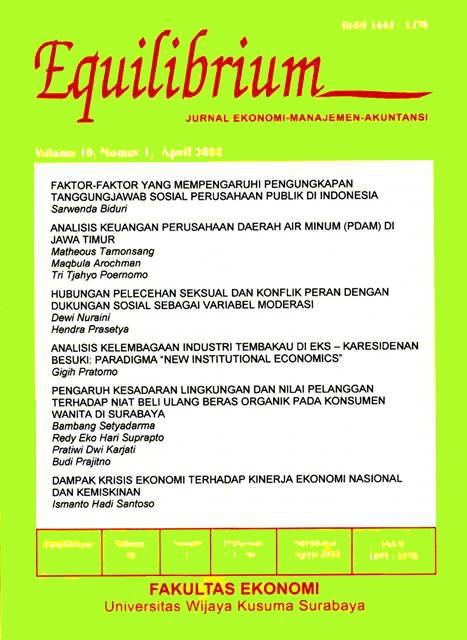
HUBUNGAN PELECEHAN SEKSUAL DAN KONFLIK PERAN DENGAN DUKUNGAN SOSIAL SEBAGAI VARIABEL MODERASI
DOI:
https://doi.org/10.30742/equilibrium.v10i1.124Keywords:
sexual harassment, social support, role conflictAbstract
The issue of sexual harassment had attention from the larger enterprises and the mass media of the 1980, because there is an increase in job or profession for women, especially in traditional work environments. One of the professions that are vulnerable to sexual harassment was a caddy female profession, which in this study as sample. The hypothesis proposed in this study were sexual harassment and social support had significant impact on role conflict and sexual harassment had significant impact on role conflict with social support as moderated variable. Testing the hypothesis in this study using simple, multiple and moderation regression to know social support as the independent variable or moderation variable. The result of this research showed that sexual harassment and social support had significant impact on role conflict. Beside that, sexual harassment had significant impact on role conflict with social support as moderated variable, so social support can act as an independent variable, as well as moderated variables.References
Caplan, R. D., Cobb, S., French Jr. J. R. P., Van Harrison, R., & Pinneau, S. P. 1975. Job Demands and Worker Health: Main Effects and Occupational Differences (HEW Publication No. NIOSH 75-160). Washington, DC: Government Printing Office.
Clark, H. K., Murdock, N.L. & Koetting, K. 2009. Predicting burnout and career choice satisfaction in counseling psychology graduate students. The Counseling Psychologist. 37 (4580-606). SAGE Publications
Cleveland, J. N & Kerst, M. E. 1993. Sexual harrasment and perceptions of power: an under-articulated relationship. Journal of Vocational Behavior. 49-67.
George, J. M. & Joner G.R. 2002. Organizational Behavior. Third Edition. New Jersey: Prentice Hall.
Hogler, R. L., Frame, J.H. & Thomson, G. 2002. Workplace sexual harrasment law: An empirical analysis of organizational justice and legal policy. Journal of Managerial Issues, 14: 234-250.
Lee, J. A, Welbourne, J.L., Hoke, W.A & Beggs, J. 2009. Examining the interaction among likelihood to sexually harass, ratee attractiveness, and job performance. Journal of Management, 35(2): 445-461
Luthans, F. 2006. Perilaku Organisasi. Edisi Kesepuluh. Yogyakarta: Penerbit Andi.
Maslach, C., Schaufeli, W. B. & Leiter, M. P. 2001. Job burnout. Annual Review of Psychology, 52: 397-422.
Peterson, M. F. 1995. Role conflict, ambiguity, and overload: A 21- Nation Study, Academy of Management Journal,Vol 38.
Ray, E. B., & Miller, K. L. 1994. Social support, home/work stress, and burnout: Who canhelp? Journal of Applied Behavioral Science, 30: 357-373.
Raver, J.L. & Gelfand, M.J. 2005. Beyond individual victim: Linking sexual harrasment, team processes, and team performance. Academy of Management Journal. Vol 48: 387-400.
Robbins, S. P. 2008. Perilaku Organisasi. Edisi Kesepuluh. Jakarta: PT. Indeks.
Setles, I. H., Sellers, R.M. & Damas, Jr., A. 2002. One Role or Two? The Function of Psycological Separation in Role Conflict. Journal of Applied Psychology, 87(3): 574-582.
Willis, T. A. & Fegan, M. F. 2001. Handbook of Health Psychology (pp. 209-234). New Jersey: Lawrence Erlbaum.
Downloads
Issue
Section
License
Authors who publish with this journal agree to the following terms:
- Authors retain copyright and grant the journal right of first publication with the work simultaneously licensed under a Attribution-ShareAlike 4.0 International (CC BY-SA 4.0) License that allows others to share the work with an acknowledgement of the work's authorship and initial publication in this journal.
- Authors are able to enter into separate, additional contractual arrangements for the non-exclusive distribution of the journal's published version of the work (e.g., post it to an institutional repository or publish it in a book), with an acknowledgement of its initial publication in this journal.
- Authors are permitted and encouraged to post their work online (e.g., in institutional repositories or on their website) prior to and during the submission process, as it can lead to productive exchanges, as well as earlier and greater citation of published work