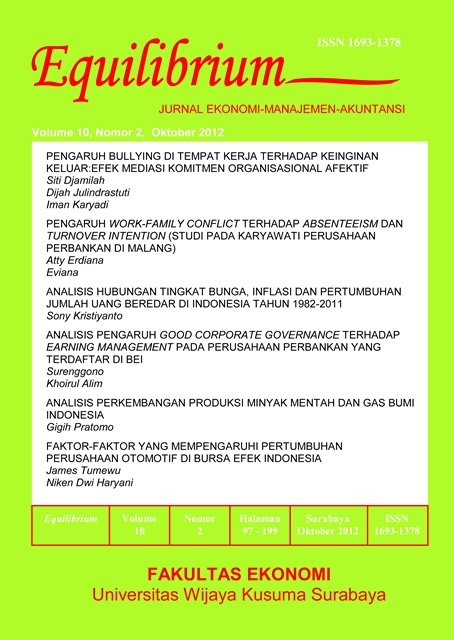
PENGARUHBULLYING DI TEMPAT KERJA TERHADAP KEINGINAN KELUAR: EFEK MEDIASI KOMITMEN ORGANISASIONAL AFEKTIF
DOI:
https://doi.org/10.30742/equilibrium.v10i2.129Keywords:
workplace bullying, affective organizational commitment, intention to leaveAbstract
This study examined the effect of affective organizational commitment as a mediating variable of workplace bullying and intention to leave. This study tested tothe company's employees in Surabaya, Sidoarjo, Gresik and Mojokerto. Questionnaires were distributed to 120 respondents and was completed by 111 respondents. The next step, researchers examined the validity and reliability of variables: affective organizational commitment, workplace bullying and intention to leave. All the variables have good validity and reliability. Hierarchical regression was used to examine the effects of affective organizational commitment as a mediating variable of workplace bullying and intention to leave. Hierarchical regression results indicate that the effect of affective organizational commitment as a mediating variable of workplace bullying and intention to leave was rejected. Affective organizational commitment better as the independent variable of intention to leave. Thus, the intention to leave is influenced by affective organizational commitment and workplace bullying.References
Allen, N. J. & Meyer, J. P., &1990. The measurement and antecedents of affective, continuance and normative commitment to the organization. Journal of Occupational Psychology, 63: 1-18.
Begley, T. M. 1998. Coping strategies as predictors of employee. Journal ofOccupational and Organisational Psycholog, 305-329.
Bowling, N.A. &Beehr, T.A. 2006. Workplace harassment from the victim's perspective: a theoretical model and meta-analysis. The Journal of Applied Psychology,(5):998-1012.
Di Martino, V., Hoel, H., & Cooper, C. L. 2003. Preventing Violence and Harassment in The Workplace. Dublin: European Fundation for the Improvement of Living and Working Conditions.
Einarsen, S. 1999. The nature and causes of bullying at work. International Journal of Manpower, (20): 16-27.
Einarsen, S., Hoel, H., Zapf, D. & Cooper, C. L. 2003. The concept of bullying at work: The European tradition. In S. Einarsen, H. Hoel, D. Zapf & C. L. Cooper, Bullying and Emotional Abuse in the Workplace: International Perspectives in Research and Practice (pp. 3-30). London: Taylor & Francis.
Einarsen, S. & Skogstad, A. 1996. Bullying at work: Epidemiological findings in public and private organizations. European Journal of Work and Organizational Psychology, (5): 185-201.
Einarsen, S. & Raknes, B. 1997. Harassment at work and the victimization of men.Violence and Victims,12: 247 - 263
Hair, Jr., Anderson, R.E., Tatham, R.L., & Black, W.C. 1998. Multivariate Data Analysis. New Jersey: Prentice-Hall International, Inc.
Hoel, H. & Cooper, C. 2000. Destructive conflict and bullying at work. Unpublished Report,UK: University of Manchester Institute of Science & Technology
Hoel, H., Einarsen, S. & Cooper, C. L. 2003. Organisational effects of bullying. I S. Einarsen, H. Hoel, D. Zapf & C. L. Cooper (Eds.), Bullying and emotional abuse in the workplace. International Perspectives in Research and Practice (ss. 145-162). London: Taylor & Francis.
Krausz, M., Koslowsky, M., Shalom, N., & Elyakim, N. 1995. Predictors of intentions to leave the ward, the hospital, and the nursing profession: A longitudinal study.Journal of Organizational Behavior, 16 (3): 277–288.
Keashly, L., Harvey, S. R., & Hunter, S. 1997. Abusive interaction and role state stressors: Relative impact on student residence assistant stress and work attitudes. Work & Stress, 11:175–185.
McCormack, D., Casimir, G., Djurkovic, N., & Yang, L. 2009. Workplace bullying and intention to leave among schoolteachers in China: the mediating effect of affective commitment. Journal of Applied Social Psychology, 39 (9): 2106–2127.
Meyer, J.P. & Allen, N.J. 1991. A three component conceptualization oforganizational commitment. Human Resource Management Review, 1: 61-98
Privitera, C. & Campbell, M. A. 2009. Cyberbullying : the new face ofworkplace bullying?.Cyber Psychology and Behavior, 12(4): 395-400.
Quine, L. 2001. Workplace bullying in nurses. Journal of Health Psychology, (6): 73-84
Robbins, S.P. 1998. Organizational Behavior. 8th edition. New Jersey: Prentice Hall
Sekaran,U. 1992. Research Methods in Business. Second edition. Canada: John Willey & Sons,Inc
Singarimbun, M.1995. Metode Penelititan Survei. Jakarta: LP3S.
Tepper, B. J. 2000. Consequences of abusive supervision. Academy of ManagementJournal, 43(2), 178–190.
Wasti, S. A. 2003. Organizational commitment, turnover intentions and the influence of cultural values. Journal of Occupational and Organizational Psychology, 76 (3): 303-321.
Downloads
Issue
Section
License
Authors who publish with this journal agree to the following terms:
- Authors retain copyright and grant the journal right of first publication with the work simultaneously licensed under a Attribution-ShareAlike 4.0 International (CC BY-SA 4.0) License that allows others to share the work with an acknowledgement of the work's authorship and initial publication in this journal.
- Authors are able to enter into separate, additional contractual arrangements for the non-exclusive distribution of the journal's published version of the work (e.g., post it to an institutional repository or publish it in a book), with an acknowledgement of its initial publication in this journal.
- Authors are permitted and encouraged to post their work online (e.g., in institutional repositories or on their website) prior to and during the submission process, as it can lead to productive exchanges, as well as earlier and greater citation of published work