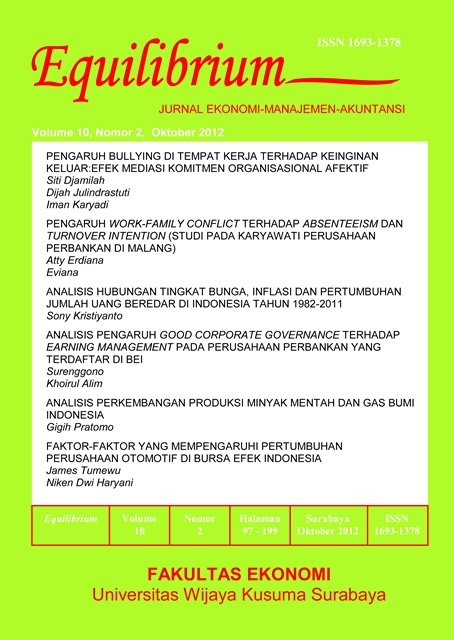
PENGARUH WORK-FAMILY CONFLICT TERHADAP ABSENTEEISM DAN TURNOVER INTENTION (STUDI PADA KARYAWATI PERUSAHAAN PERBANKAN DI MALANG)
DOI:
https://doi.org/10.30742/equilibrium.v10i2.130Keywords:
work family conflict, family work conflict, absenteeism, turnover intentionAbstract
Work-family conflict is a form of inter-role conflict in which the role pressures from the work and family field contradictory. This means that participation in the family role or job complicate implementation responsibilities in other roles. Conflict between work and family is important for organizations and individuals as it can lead to a number of negative effects, such as increased absenteeism, increased turnover, decreased performance and physical health and poor mental. This study aims to determine the effect of work family conflict and family work conflict on absenteeism and turnover intention.A study conducted on employee banking company in Malang, with 94 employees as respondents.The results of multiple regression showed that the higher family - work conflict, the absenteeism from work will also be high, and the higher the family - work conflict, the turnover intention will also be high. When someone runs a variety of roles as workers, as a partner in the household and as a parent, every role will require time, energy and commitment. The difficulty to be able to balance the demands of family and job demands encourage employees to move work and look for another job which they think can set the time, both for the family and the job.References
Abbott, J., Cieri, H.D., & Iverson, R. D. 1998. Costing turnover : Implication of work/family conflik at management level.Asia Pasific of Journal of Human Resource, 36 (1): 25-43.
Aryee, S., Luk, V., & Stone, R. 1998. Family responsive variabels andretention-relevant outcomes among employed parents. Human Relations, 51(1): 73-87.
Blau, G. 1995.. Influence of group lateness on individual lateness: A. cross-level examination. Academy of Management Journal. Vol. 38: 1483-1496.
Cascio , W. F. 1998.Managing Human Resources : Productivity, Quality of Work Life ,Profits.Fifth Edition. New York: Irwin McGraw –Hill.
Cooper Donald R. & Emory, C.W. 1999.Metode Penelitian Bisnis. Jakarta: Erlangga.
Greenhaus, J.H.& Beutell,N.J.1985.sources of conflict between work and family roles.The Academy of Management Review, 10 (1): 76-88.
Hendrix, W.H., Spencer, B.A., & Gibson, G. S. 1994. Organizational and extraorganizational factors affecting stress, employee well-being, and absenteeism for males and females.Journal of Business and Psychology, 9(2): 103-128.
Indriantoro, N. dan Supomo, B. 1999.Metodologi Penelitian Bisnis.Edisi pertama. Yogyakarta: BPFE
Karatepe, O. M., Uludag O., Menevis, I. Hadzimehmedagic, L.& Baddar, L. 2006. The effects of selected individual characteristics on frontline employee performance and job satisfaction. Journal of Tourism Management, 27:547–560
Martocchio, J. J. 1992. The financial cost of absence decision. Journal of Management, 18(1): 133-152.
Mobley, W. H.1996. Pergantian Karyawan : Sebab Akibat dan Pengendaliannya. Jakarta: Penerbit PPM.
Netemeyer, R. G., Boles, J. S., & McMurrian, R. 1996. Development and validation of work-family conflict and family-work conflict scales. Journal of Applied Psychology, 81(4): 400-410.
Nunnally, J.C.1978. Psychometric Theory. New york: Mc Graw-Hill.
Singarimbun, M.& Effendi, S. 1995.Metode Penelitian Survai. Jakarta: LP3ES.
Small, S.A., & Riley, D. 1990. Toward a multidimensional assessment of work spillover into family life. Journal of Marriage and the Family, 52: 51-61
Steers, R.M., & Rodes, S.R. 1978. Majorinfluence on employee attendance: A process Model. Journal of Applied Psychology,63(4): 391-407.
Vinokur, A.D., Pierce, P.F., & Buck, C.L. 1999. Work family conflict of women in the air force: their influence on mental health and functioning.Journal of Organizational Behavior, Vol. 20: 865-878.
Zeffane, R.1994. Understanding employee turnover: the need for a contingency approach. International Journal of Manpower, 15(9): 1-14.
Downloads
Issue
Section
License
Authors who publish with this journal agree to the following terms:
- Authors retain copyright and grant the journal right of first publication with the work simultaneously licensed under a Attribution-ShareAlike 4.0 International (CC BY-SA 4.0) License that allows others to share the work with an acknowledgement of the work's authorship and initial publication in this journal.
- Authors are able to enter into separate, additional contractual arrangements for the non-exclusive distribution of the journal's published version of the work (e.g., post it to an institutional repository or publish it in a book), with an acknowledgement of its initial publication in this journal.
- Authors are permitted and encouraged to post their work online (e.g., in institutional repositories or on their website) prior to and during the submission process, as it can lead to productive exchanges, as well as earlier and greater citation of published work