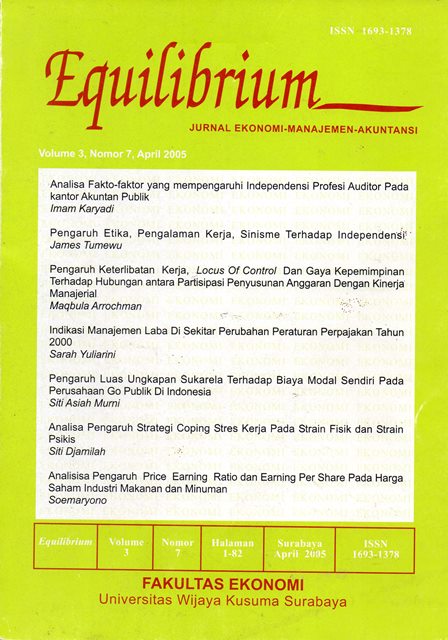
PENGARUH KETERLIBATAN KERJA, LOCUS OF CONTROL DAN GAYA KEPEMIMPINAN TERHADAP HUBUNGAN ANTARA PARTISIPASI PENYUSUNAN ANGGARAN DENGAN KINERJA MANAJERIAL
DOI:
https://doi.org/10.30742/equilibrium.v3i7.203Keywords:
Budget participation, managerial performance, work involvement, locus of control, leadership style, concideration, initiative structureAbstract
The relationship between budget participation and managerial performance which has been studied in several research in accounting has achieved inconsistent result. One of the way to reconcile these inconsistencies is to study the problem using contingency approach (Govindarajan, 1986). This research endeavors to find a solution to this inconsistencies by applying contingency approach. Three contingency variables are studied here, that is work involvement, locus of control, and leadership style. Questionnaire is sent to 290 manufacturing companies in East Java, resulting in responses from 56 managers (19,3%) which are then submitted into regression analysis. This study shows that, first, the result of the analysis reject the hypothesis that interaction between work involvement and budget participation affects managerial performance. Second, the result of the analysis confirms that threre exists an interactional effect of locus of control and budget participation toward managerial performance. Third, the result of the analysis reject the hypothesis that the effect of budget particiption toward performance is hight for consideration leadership style, which is consistence with the result from Safriliana (2001) and the result of the analysis also reject the hypothesis that the effect of budget participation toward managerial performance is low for initiative leadership style. The latter finding is also consistent with the result from Safriliana (2001).References
Chow, C.W., C.C. Jean , dan S.W. William. 1988. Participation Budgetary Effect of a Truth Inducing Pay Scheme and Information Asymmetry on Slack and Performance. The Accounting Review. No. 1. Januari: hal. 111-122.
Govindarajan, V. 1986a. Impact of Participation in The Budgetary Process on Managerial Attitude and Performance: Universalistic and Contengency Perspective. Decision Sciences: hal. 496-516.
Kanungo, R.N. 1982. Measurement of Job and Work Involvement. Journal of Applied Psychology. Vol. 67. hal.341-349.
Kennis, I. 1979. Effect of Budgetary Goal Characteristics on Managerial Attitude and Performance. The Accounting Review. Vol 54. Oktober: hal. 702-721.
Kren, L. 1992. Budgetary, Budgetary Participation and Managerial Performance: The Impact of Information and Environmental Volatality. The Accounting Review. Vol 67. Juli : hal . 512.
Mahoney, T.A., T.H. Jerdes, dan S.J. Carrot. 1963. Development Managerial Performance: A Research Approach. South Western Publishing Co.
Murray, D. 1990. The Performance Effect of Participative Budgeting: An Integration of Intervening and Moderating Variables, Behavioral Research in Accounting. Vol. 2.hal: 104-123.
Nouri, H. dan R.J. Parker. 1996. The Effect of Organizational Commitment on Relation Between Budgetary Participation and Budgetary Slack. Behavioral Research in Accounting . Vol. 8:hal 74-89.
Robbins, S.P., Alih bahasa: Halida dan Sartika, D., 2002. Perilaku Organisasi. Edisi Kelima. Jakarta. Penerbit Erlangga.
Yulk, G.A. 1989. Leadership in Organizations. Second Edition. Prentice Hall International, Inc. New Jersey.
Downloads
Issue
Section
License
Authors who publish with this journal agree to the following terms:
- Authors retain copyright and grant the journal right of first publication with the work simultaneously licensed under a Attribution-ShareAlike 4.0 International (CC BY-SA 4.0) License that allows others to share the work with an acknowledgement of the work's authorship and initial publication in this journal.
- Authors are able to enter into separate, additional contractual arrangements for the non-exclusive distribution of the journal's published version of the work (e.g., post it to an institutional repository or publish it in a book), with an acknowledgement of its initial publication in this journal.
- Authors are permitted and encouraged to post their work online (e.g., in institutional repositories or on their website) prior to and during the submission process, as it can lead to productive exchanges, as well as earlier and greater citation of published work