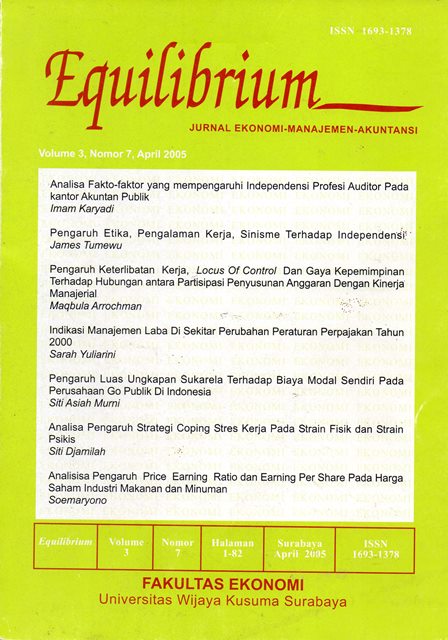
ANALISA PENGARUH STRATEGI COPING STRES KERJA PADA STRAIN FISIK DAN PSIKIS (STUDI KASUS DI RUMAH SAKIT UMUM DI YOGYAKARTA)
DOI:
https://doi.org/10.30742/equilibrium.v3i7.206Keywords:
Occupational stress, problem focused coping, emotion focused coping, social support, religiosity, physiological and psychological strains.Abstract
This research examined the influence of occupational stress coping strategies on physiological and psychological strains. Specifically, this study analyzed the effectiveness of coping strategy which comprised: problem focused coping, emotion-focused coping, supervisor's support and co-worker's support (social support) and religiosity in maintaining physiological and psychological health. This research tested to nurses in one of general hospitals in Yogyakarta, because of the attribute of nurse profesion very suitable for the research of occupational sress. One hundred and ten questionnaires were distributed, 104 questionnaires returned and only 100 questionnaires were able to be used. Next step, the researcher examined validity and reliability testing which delivered independent variable: those were active coping and planning dimension as representation of problem focused coping; acceptance and denial as the representation of emotion focused coping; social support (supervisor and co-worker); religiosity that had close friend subject. Beside that, it delivered dependent variable that were physiological and psychological strains. Multiple regressions was used to examined the effect of four coping strategies toward physiological and psychological strains. Moreover it also used hierarchical regressions to prove the ability of problem focused coping to explained the bigger proporsion of physiological and psychological strains variance beyond the ability of three others. The result of multiple regressions indicated that the effect of four coping strategies toward physiological strains were not supported. In the other hand, The result of multiple regression proved that social support had influence on the decreasing of psychological strain. Beside that religiosity also gave influence on psychological strain, but into different direction that was increasing psychological strain. The result of hierarchical regressions showed that problem focused coping explained the bigger proporsion of psychological strain variance beyond the ability of three others.References
Aldwin, C.M. & Revenson, T.A. 1987. Does coping help? A reexamination of the relation between coping and mental health. Journal of Personality and Social Psychology, 53 (2): 337-348.
Armeli, S., Carney, M.A., Tennen, H., Affleck, G. & O'Neil, T.P. 2000. Stress and alcohol use: a daily process examination of the stressor-vulnerability model. Journal of Personality and Social Psychology, 78 (5): 979-994
Beehr, T.A.; Fenlason, K.J. & Gudanowski, D.M. 1996. Work and stress: implications for human resource management. Human Resources Management, 3: 449- 460.
Beehr, T.A., Johnson, L.B. & Nieva, R. 1995. Occupational stress: coping of police and their spouses. Journal of Organizational Behavior, 16: 3-25. Beit-Hallahmi, B. & Argyle, M. 1997. The Psychology of Religious Behaviour, Belief and Experience. First edition. London: Routledge.
Bernardin, H.J. & Russel, J.E.A. 1998. Human Resources Management. Second edition. Boston: Irwin.
Briner, R.B. & Reynolds, S. 1999. The cost, benefits, and limitations of organizational level stress interventions. Journal of Organizational Behavior, 20: 647-664.
Carver, C.S., Scheier, M.F. & Weintraub, J.K. 1989. Assesing coping strategies: a theoretically based approach. Journal of Personality and Social Psychology, 56 (2): 267-283.
Cooper, C.L. 1983. Stress Research. First edition. New York: John Wiley Sons.
Ferdinand, A. 2000. Structural Equation Modeling Dalam Penelitian Manajemen. Edisi kesatu. Semarang: Badan Penerbit Universitas Diponegoro.
Fisher, R.J. 1993. Social desirability bias and the validity of indirect questioning. Journal of Consumer Research, 20: 303-315.
Folkman, S., Lazarus, R.S., Gruen, R.J. & DeLongis, A. 1986, Appraisal, coping, health status and psychological symptoms. Journal of Personality and Social Psychology, 50 (3): 571-579.
Fox, M.L., Dwyer, D.J. & Ganster, D.C. 1 993. Effects of stressful job demands and control on physiological and attitudinal outcomes in a hospital setting. Academy of Management Journal, 36 (2): 289-318.
Greenberg, J. & Baron, R.A. 2000. Behavior In Organizations. Seventh edition. New Jersey: Prentice Hall, Inc.
Gunthert, K.C., Cohen, L.H. & Armeli, S. 1999. The role of neuroticism in daily stress and coping. Journal of Personality and Social Psychology, 77 (5): 1087 1100.
Holahan, C.J., Holahan, C.K., Moos, R.H. & Brennan, P.L. 1997. Social contTMxt, coping strategies, and depressive symptoms: an expanded model with cardiac patiens. Journal of Personality and Social Psychology, 72 (4): 918-928.
Hurrel, Jr., J.J. 1995. Police work, occupational stress and individual coping. Journal of Organizational Behavior, 16: 27-28.
Indarjati, Arie. 1996. Peran dukungan sosia] da]am mengatasi stres kerja pada wartawan. Tesis. MM-UGM.
Jamal, M. & Baba, V. 1992. Shiftwork and departement-type related to job stress, work attitudes and behavioral intentions : a study of nurses. Journal of Organizational Behavior, 13: 449-464.
Jex, S.M., Beehr, T.A. & Roberts, C.K. 1992. The meaning of occupational stress item to survey respondents. Journal ofApplied Psychology, 77 (5): 623-628.
Latack, J.C. & Havlovic, S.J. 1992. Coping with job stress: a conceptual evaluation framework for coping measure Journal of Organizational Behavior13:479-508
Leana, C.R., Feldman, D.C. & Tan, G.Y. 1998. Predictors of coping behavior after a layoff. Journal of Organizational Behavior, 19: 85-97.
Menon, G., Bickart, B., Sudman, S. & Blair, J. 1995. How well do you know your partner? Strategies for formulating proxy-reports and their effects on convergence to self-reports. Journal of Marketing Research, February: 75-84.
Parasuraman, S., Greenhaus, J.H. & Granrose, C.S. 1992. Role stressor, social support and well-being among two-career couples. Journal of Organizational Behavior, 13: 339-356.
Pervin, L.A. & John, O.P. 1999. Handbook of Personality. Second edition. New York: Guilford Press.
Ray, E.B. & Miller, K.I. 1994. Social support, home/work stress, and burnout: who can help?. Journal of Applied Behavioral Science, 30 (3): 357-373.
Scheck, C.L. & Kinicki, A.J. 2000. Identifying the antecedents of coping with an organizational acquisition: a structural assessment. Journal of Organizational Behavior, 21: 627 - 648.
Sekaran, U. 1992. Research Methods for Business. Second edition. Canada: John Willey & sons, Inc.
Seltzer, J. & Bass, B. M. 1990. Transformational leadership: beyond initiation and consideration. Journal of Management, 16 (4): 693-703.
Singarimbun, M. & Effendi, S. 1995. Metode Penelitian Survai. Edisi kedua. Jakarta: LP3ES
Stephens, C. & Long, N. 2000. Communication with police supervisors and peers as buffer of work-related traumatic stress. Journal of Organizational Behavior, 21: 407-424.
Sullivan, S.E. & Bhagat, R.S. 1992. Organizational stress, job satisfaction and job performance: where do we go from here ? Journal of Management, 18 (2): 353-374.
The American Institute of stress. 2001. The quandary of job stress compensation. The Newsletter of The American Institute of Stress, number 3: 1-8.
Tosi, H.L., Rizzo, J.R. & Carroll, S.J. 1990. Managing Organizational Behavior. Second edition. New York: Harper Collins Prblishers.
Wofford, J.C., Goodwin, V.L. & Daly, P.S. 1999. Cognitive-affective stress propensity: a field study. Journal of Organizational Behavior, 20: 687-707.
Zautra, A.J. & Wrabetz, A.B. 1991. Coping success and its relationship to psychological distress for oleder adults. Journal of Personality and Social Psychology, 61 (5): 801-810.
Downloads
Issue
Section
License
Authors who publish with this journal agree to the following terms:
- Authors retain copyright and grant the journal right of first publication with the work simultaneously licensed under a Attribution-ShareAlike 4.0 International (CC BY-SA 4.0) License that allows others to share the work with an acknowledgement of the work's authorship and initial publication in this journal.
- Authors are able to enter into separate, additional contractual arrangements for the non-exclusive distribution of the journal's published version of the work (e.g., post it to an institutional repository or publish it in a book), with an acknowledgement of its initial publication in this journal.
- Authors are permitted and encouraged to post their work online (e.g., in institutional repositories or on their website) prior to and during the submission process, as it can lead to productive exchanges, as well as earlier and greater citation of published work