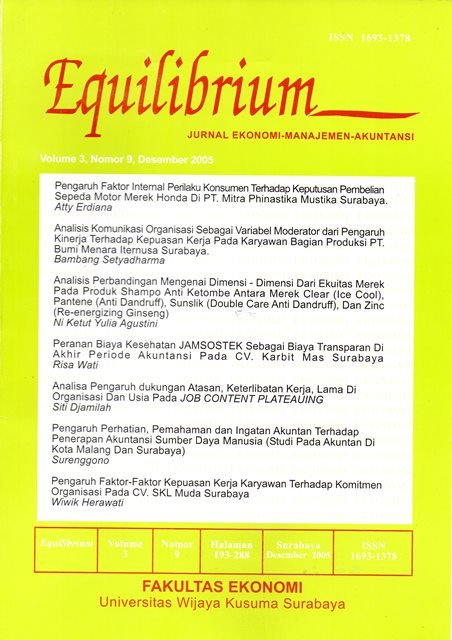
PENGARUH PERHATIAN, PEMAHAMAN DAN INGATAN AKUNTAN TERHADAP PENERAPAN AKUNTANSI SUMBER DAYA MANUSIA (Studi Pada Para Akuntan di Kota Malang dan Surabaya)
DOI:
https://doi.org/10.30742/equilibrium.v3i9.223Keywords:
attention, comprehension and retention of Accountant, the implementation of Human Resources AccountingAbstract
The purpose of this study is to analyze the influence of attention, comprehension and retention of accountant toward the implementation of Human Resources Accounting whether it is in individual or even in together. Research sample are Accountants that working at Malang and Surabaya City by respondents that consist of many accountants. They are public accountant, educator accountant and intern accountant. Measurement used in this study has perceptional characteristics. Correlation analysis used in this study is to examine the relation between independent and dependent variables, and multiple regression analysis to know the influence of independent and dependent variables. The result of 1st 2nd and 3th hypothesis examination can be known that in partial there is any significant relation between independent variabel that is attention (Xl), comprehension (X2) and retention (X3) toward dependent variable that is implementation of Human Resources Accounting (Y). From the result of fourth hypothesis, by using F-test, that simultaneously there is any significant relationship independent variable, that is attention (Xl), comprehension (X2) and retention (X3) toward dependent variable, that is the implementation of Human Resources (Y). From the result of analysis, it can be known that the most dominant independent variables that influence dependent variable is comprehension variable (by the assumption of other variable that has constant characteristics).References
Assael, Henry. (1992), Consumer Behavior & Marketing Action, Fourth Edition, PWS-KENT Publismg Company Boston.
Belkaouni, Riahi Ahmed, (2000), Accounting Theory, 4th edition, Thomson Learning, Singapore.
Cushing, E. Barry and Romney B. Marshall, (1990), Accounting Information System, 5th Edition, Addision Wisley Publishing Company.
Dawson, Chris, (1994), Human Resources Accounting : From Prescription to Description?, Management Decision, Vol. 32 Iss 6, June
Firstenberg, B. Paul, (1993), Downsizung; What Your Game Plan?, Management Review,Vol 82,Iss 11, Nov.
Flamholtz, G. Eric, (1986), Human Resources Accounting ; Advences in Concept Methode And Applications, 2rd Edition, Jossey Bassn Publishers, San Francisco.
Flamholtz, G. Eric, (1989), Behavioral Accounting, Human Resource Accounting and Overview, South Western Publishing Co.
Gibson, I. James, James, D.H. Yr., And Invancevich M. John., (1995), Fundamentals Management, 9th, Richard D. Irwin.Inc.
Hendriksen, S Eldon and Breda F, Michael, (2000), Accounting Theory, 5th Edittion, Ricard D. Irwin Inc.
Indrawijaya, Ibrahim, A., (1983), Perilaku Organisasi, Sinar Baru, Bandung.
IAI, (1994), Standard Akuntansi Keuagan, Salemba Empat, Jakarta.
Parry, B. Scott, (1996), Measuring Training "s ROI, HRD Cost, Benefit Analysis, Training and Development, May.
Sekaran, U. 1992. Research Methods in Business. Second edition. Canada: John Willey & Sons, Inc.
Sugiyono, (1994), Metode Penelitian Administrasi, Alfabeta Bandung
Randal, Schuler S., and Susan, Jackson E., (1996), Human Resource Management 6th Edition, Alih Bahasa Nurdin Sobari dan Tulus Tobing, West Publishing Company.
Vakharia, P. Russel, (1995), Financial Accounting of human Capital Polecies, Cost Engineering, VI 31, Iss 7.
Wether, B. William Jr. and Davis, K., (1993), Human Resource and Personel Management, Mc. Graw-Hill Inc.
Downloads
Issue
Section
License
Authors who publish with this journal agree to the following terms:
- Authors retain copyright and grant the journal right of first publication with the work simultaneously licensed under a Attribution-ShareAlike 4.0 International (CC BY-SA 4.0) License that allows others to share the work with an acknowledgement of the work's authorship and initial publication in this journal.
- Authors are able to enter into separate, additional contractual arrangements for the non-exclusive distribution of the journal's published version of the work (e.g., post it to an institutional repository or publish it in a book), with an acknowledgement of its initial publication in this journal.
- Authors are permitted and encouraged to post their work online (e.g., in institutional repositories or on their website) prior to and during the submission process, as it can lead to productive exchanges, as well as earlier and greater citation of published work