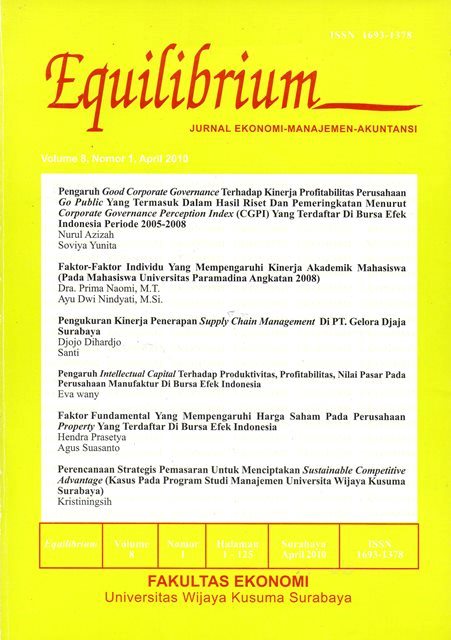
FAKTOR-FAKTOR INDIVIDU YANG MEMPENGARUHI KINERJA AKADEMIK MAHASISWA (PADA MAHASISWA UNIVERSITAS PARAMADINA ANGKATAN 2008)
DOI:
https://doi.org/10.30742/equilibrium.v8i1.300Keywords:
openness to ableness, experiencess constitousness, extraversion, agreeableness, neuroticism, kinerja akademikAbstract
Tujuan penelitian ini untuk membuktikan apakah openness to ableness, experiencess constitousness, extraversion, agreeableness, neuroticism berpengaruh tehadap kinerja akademik. Populasi penelitian adalah mahasiswa Universitas Paramadina angkatan 2008, maka pengambilan sampel menggunakan purposive sampling. Penelitian ini menggunakan alat analisis regresi berganda. Hasil pengaruh faktor kepribadian terhadap kinerja akademik sebagai berikut: Openess to experiences tidak terbukti berpengaruh positif terhadap kinerja akademik, Conscientiousness berpengaruh positif terhadap kinerja akademik, Extraversion berpengaruh negatif terhadap kinerja akademik, Agreableness tidak terbukti berpengaruh positif terhadap kinerja akademik, Neuroticism berpengaruh positif terhadap kinerja akademikReferences
Ackerman, P.L., & Heggestad, E.D. (1997). Intellligence, personality, and interests: Evidence for overlapping traits, Psychologicalo Bulletin, 121, 219-245.
Ackermeam. P.L., Bowen, K.R., Beier, M.E., & Kanfer, R (2001). Determinants of Individual Differences and Gender Differences in knowledge. Journal of Educational Psychology, 93, 797-825.
Airasian P., (2001), Classroom Assesment (4th edition), New York.
McGraw-Hill. Azwar (2005), Penyusunan Skala Psikologi, Yogyakarta, Pustaka Pelajar
Bauer, K.W., & Liang, Q (2003). The Effect of Personality and Pre college characteristics on first-year activities and academic performance, Journal of College Student, 44, 277-290.
Bloom, Benjamin S.M., George F.Hastings, J.Thomas (1981). Evaluation to improve Learning, New York, David McKay.
Cattell, R.B.(1973). Personality and Mood by Questionnaire, New York : Jossey-Bass.
Chammoro-Premuzic, T., & Furnham, A. (2003), Personality predicts academic performance: Evidence from two longitudinal university samples. Journal of Research in Personality. 37, 319-338.
Conard, M.A. (2006) Aptitude is not enough : How Personality and Behaviour Predict Academic Performance, Journal of Research in Personality. 40, 339-346.
Costa, P.T. & McCrae, R.R. (1992) Revised NEO Personality Inventory, Lutz, FL. Cronbach (1975), Essential of Psychological Testing, New York, Harper & Row Publisher.
De Fruyt, F., & Mervielde, I (1996). Personality and interests as predictors of educational streaming and achievement. Europian Journal of Personality, 10, 405-425
Dollinger, S.J. & Orf, L.A.,(1991) Personality and performance in "personality" Conscientiousness and Openness. Journal of Research in Personality, 25, 276-284.
Eysenck, H.J. (1970). The structure of human persoanality (3ed Edition), London: Methuen.
Fairsides, T., & Woodfield, R, (2003) Individual differecess and undergraduate academic success The role of Grades. Personality & Individual Derences. 34. 1225-1243.
Feist, J. dam Feist, J. G. (2006). Theories of Personality, Sixth Edition. New York: McGraw Hill Companies
Furnham, A. & Chamorro-Premuzic, 2004. Personality and Intelligence as predictors of statistics examination grades. Personality and Individual Differences, 14, 49-66.
Furnham, A., Chamorro-Premuzic & McDougall, F.(2003). Personality, Cognitif Ability, and Belief about intelligence as predictors of academic performance. Learning and Individual Differencess. 14, 49-66.
Goff.M., & Ackerman, PL. (1992) Personality - Intelligence relations : Assesment of typical intellectual engagement, Journal of Educations Psychology, 84, 537-552.
Goldberg, L.R. (1990) An Alternative Description of Personality : The Big Five Factor Structure, Journal of Personality and Social Psychology, 59, 1216 - 1229.
Gray, E.K., & Watson, D. (2002), General and specific traits of personality and their relation to sleep and academic performance. Journal of Personalitv70. 177 - 206.
Hogan, R., Johnson, J. & Li ( 11 ) ti Handbook nf Personality Psychology. California: Academic Pres.
Kaplan, R. M. & Sacauzzo,) P. (%005) Psychological Testing: principles, applications, and issues, 6th edition California.
Kruck, S.E. & Lending, . (2003). Predicting Academic Performance in an Introductory College-Level IS Course. Information Technology, Lcarai na, and Performance Journal, Vol. 21, No. 2. 9 – 15
Lievens, F., Coetsier, P., De Fruyt, F., & De Maeseneer, J. (2002) Medical Students Characteristics and Academics performance ; A five-factor model perspective, Medical Education. 36, 1050 - 1056.
Lounsburry, J.W., Sundstroin, E., Loveland, J.M., & Gibson, L.W. (2003). Intelligence, Bif Five Personality traits, and work drive as predictors of course grade. Personality and Individual Differences', 35, 1231-1239.
McAdams, D.P (1992). The Five Factor Model in Personality : A Critical Appraisal. Journal of Personality. 60, 329-360.
McCrae, R.R. & Costa, P.T., (2003). Personality in adulthood: a five-factor theory perspective, 2nd ed., New York: The Guilford Press.
McCrae, R.R., & John,O.P (1992), An Introduction to the big five-factor model and its applications. Journal of Personality, 2, 175-215.
O'Connor,. Melissa C. & Paunonen S.V. (2007). Big Five Personality Predictors of Post-secondary Academic Performance. Journal of Personality & Individual Dfferences, 43, 971-990.
Peunonen, S.V & Ashton (2001). Big Five Predictors of Academic Achievement, Journal of Research in Personality, 35, 78-90.
Phillips, P., Abraham, C., & Bond, R. (2003), Personality, cognition, and university students' examination performance. European Journal of Personality, 17, 1 448 Raja, U. & Johns, G (2004) The impact of personality on psychological contracts. Academy of management Journal, Vol. 47, h. 350 – 367
Rangga W.K. & Prima Naomi,(2007). Pengaruh Motivasi Diri terhadap Kinerja Belajar Mahasiswa (Studi pada Mahasiswa Universitas PAramadina), Jurnal Abmas, LPM UPI Bandung.
Rothstein, M.G., Paunonen, S.V., Rush, J.C., & King, g.A. (1994) Personality and cognitive ability predictors of performances in graduate business school. Journal of Educations Psychology. 86, 516 - 530.
Winkel (1991), Psikologi Pendidikan, Alumni, Bandung.
Downloads
Issue
Section
License
Authors who publish with this journal agree to the following terms:
- Authors retain copyright and grant the journal right of first publication with the work simultaneously licensed under a Attribution-ShareAlike 4.0 International (CC BY-SA 4.0) License that allows others to share the work with an acknowledgement of the work's authorship and initial publication in this journal.
- Authors are able to enter into separate, additional contractual arrangements for the non-exclusive distribution of the journal's published version of the work (e.g., post it to an institutional repository or publish it in a book), with an acknowledgement of its initial publication in this journal.
- Authors are permitted and encouraged to post their work online (e.g., in institutional repositories or on their website) prior to and during the submission process, as it can lead to productive exchanges, as well as earlier and greater citation of published work