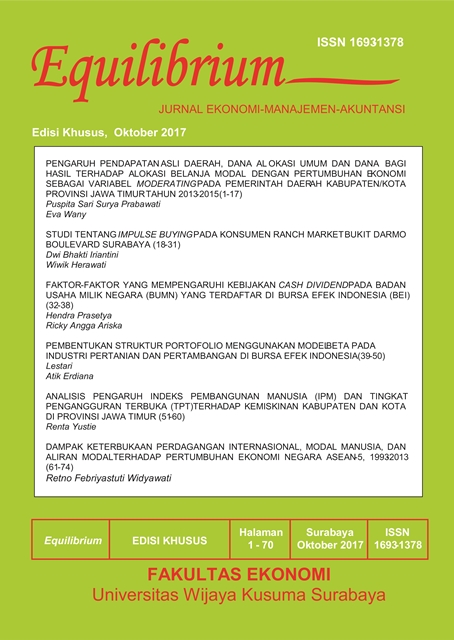
DAMPAK KETERBUKAAN PERDAGANGAN INTERNASIONAL, MODAL MANUSIA, DAN ALIRAN MODALTERHADAP PERTUMBUHAN EKONOMI NEGARA ASEAN-5, 1993-2013
DOI:
https://doi.org/10.30742/equilibrium.v0i0.419Keywords:
Economic Growth, Transparency International Trade, Human Capital, Gross Fixed Capital Formation, Typology State, and VECMAbstract
The globalization that takes place in the last few decades has led to international trade openness with regard to economic growth. The aim of this study is to examine the impact of international trade openness, the quality of human capital, and capital flows to the country's economic growth in ASEAN-5 in 1993-2013. The unit of analysis is the ASEAN-5 consists of: Indonesia, Malaysia, Philippines, Singapore, and Thailand. The method used is the typology of the State to determine the position of ASEAN-5 and Vector Error Correction Model (Vector Error Correction Model-VECM) to determine the impact of international trade openness, the quality of human capital, and capital flows as indicated by gross fixed capital formation (gross fixed capital formation) on economic growth. Results Quotients State is all ASEAN-5 changes position during the observation period 1993-2013 year. VECM results showed that the openness of international trade and the quality of human capital has a positive and significant correlation to economic growth in ASEAN-5 during the period 1993-2013. Gross fixed capital formation has a negative and significant impact on economic growth of ASEAN-5 countries during the period 1993-2013.References
Aka, Bedia, F. 2006. ‘Openness, globalization and economic growth: empirical evidence from Cote D’Ivoire’, International Journal of Applied Econometrics and Quantitative Studies, 3(2): 67-85.
Arif, Asma dan Ahmad Hasnat. 2012. ‘Impact of trade openness on output growth: co integration and error correction model approach’, International Journal of Economics and Financial Issues, 2(4): 379-385.
Arsyad, Lincolin, 2010. Ekonomi Pembangunan. YKPN: Yogyakarta.
Bashar, Omar dan Khan Habibullah. 2007. ‘Liberalization and Growth: An Eeconometric Study of Bangladesh’, Working Paper, U21 Global, Malaysia, February.
Bowen, Harry, P., Abraham Hollander, Jean Marie Viaene. 2001. Applied International Trade Analysis. The University of Michigan Press: America.
Chaundhry, Imran S., Ali M., dan M. Zahir. 2010. ‘Exploring the causality relationship between trade liberalization, human capital, and econometric growth: empirical evidence from Pakistan’. Journal of Economics and International Finance, 2(8): 175-182.
Ekananyake, E. 1999. ‘Exports and economic growth in Asian Developing Countries: cointegration and error-correction model’, Journal of Economic Development, 24(2): 43-56.
Gould, David M. dan Ruffin, Roy J. 1995. ‘Human capital, trade, and economic growth’, Journal of Economic Development, 3(2): 3-16.
Gries, T. dan Redlin, M. 2010. ‘Trade openness and economic growth: a panel causality analysis’, Journal of Development Economics, 5(1):1-19.
Hussin, Fauzi dan Saidin, Nooraini. 2012. ‘Economic growth in ASEAN-4 Countries: a panel data analysis’, International Journal of Economics and Finance, 4(9): 119-129.
Kuncoro, Mudrajad. 2009. Metode Riset Untuk Bisnis & Ekonomi (Bagaimana Meneliti & Menulis Tesis). Ed.3.Erlangga: Jakarta.
Romer, Paul N. 1994. ‘The origin of endogenous growth’, The Journal of Economic Perpective, 8(1), 3-32.
Sachithra, K., 2000. ‘Comparative advantage in international trade: a study based on leading exports in Sri Lanka’, Journal of India Economy and Business, 1: 1–35.
Seetanah, Boopen. 2012. ‘Trade openness and economic performance: an African persepctive’. Journal of Economics and Developments, 3(2): 8-23
Downloads
Published
Issue
Section
License
Authors who publish with this journal agree to the following terms:
- Authors retain copyright and grant the journal right of first publication with the work simultaneously licensed under a Attribution-ShareAlike 4.0 International (CC BY-SA 4.0) License that allows others to share the work with an acknowledgement of the work's authorship and initial publication in this journal.
- Authors are able to enter into separate, additional contractual arrangements for the non-exclusive distribution of the journal's published version of the work (e.g., post it to an institutional repository or publish it in a book), with an acknowledgement of its initial publication in this journal.
- Authors are permitted and encouraged to post their work online (e.g., in institutional repositories or on their website) prior to and during the submission process, as it can lead to productive exchanges, as well as earlier and greater citation of published work