Dampak Toxic Digital Culture terhadap Perilaku Organisasional dan Turnover Intention di Lingkungan Kerja Digital
DOI:
https://doi.org/10.30742/equilibrium.v22i1.4883Keywords:
Toxic digital culture, Organizational behavior, Turnover intention, Digital work environment, Employee well-beingAbstract
The development of digital technology has changed the way we work, but it has also brought new challenges such as a toxic digital culture, which can negatively impact organizational behavior and employees' intentions to leave their jobs. This research aims to analyze how unhealthy digital culture affects employee motivation, engagement, and the desire to leave the organization. This research uses qualitative methods, with data analysis based on literature review and documentation studies from various relevant sources. Unlike previous research that heavily relied on interviews and observations, this study explores the phenomenon of toxic digital culture through conceptual mapping and theoretical analysis. The research results show that digital overload, lack of work-life balance, and high work pressure due to instant communication expectations can increase employee stress and decrease job satisfaction. As a result, employees become less productive, experience conflicts within teams, and are more likely to have a desire to leave the company. The conclusion of this research emphasizes that toxic digital culture is an important factor that needs to be addressed in digital organization management. Companies need to implement healthy communication policies, support employee well-being, and create a more balanced work environment to reduce the negative impact of digital culture on employee retention.
References
Bakker, A.B. and Demerouti, E. (2007) ‘No Titlehe Job Demands‐Resources model: State of the art’, Journal of Managerial Psychology [Preprint].
Bürgel, T.R., Hiebl, M.R.W. and Pielsticker, D.I. (2023) ‘Digitalization and entrepreneurial firms’ resilience to pandemic crises: Evidence from COVID-19 and the German Mittelstand’, Technological Forecasting and Social Change, 186(PA), p. 122135. Available at: https://doi.org/10.1016/j.techfore.2022.122135.
Dang-Van, T. et al. (2022) ‘Investigating employees’ deviant work behavior in the hotel industry during COVID-19: Empirical evidence from an emerging country’, Tourism Management Perspectives, 44(October), p. 101042. Available at: https://doi.org/10.1016/j.tmp.2022.101042.
Metris, D. (2024) ‘Hustle Culture: Mencermati Tren Perilaku Yang Mendorong Kesuksesan Tanpa Henti’, Al-KALAM : JURNAL KOMUNIKASI, BISNIS DAN MANAJEMEN, 11(1), p. 111. Available at: https://doi.org/10.31602/al-kalam.v11i1.12053.
Metris, D., Rasyiddin, A. and Rismanto, C. (2024) Era Baru Manajemen Sumber Daya Manusia: Transformasi dan Inovasi di Dunia Digital. Tri Edukasi Ilmiah.
Mobley, W.H. (1977) ‘Intermediate linkages in the relationship between job satisfaction and employee turnover’, Journal of Applied Psychology [Preprint].
Nurrahmawati, M., Tony, A. and Prakoso, J.H. (2025) ‘Peran Komunikasi Organisasi dalam Mengubah Toxic Workplace Environment’, Jurnal Ilmiah Ilmu Pendidikan, 8, pp. 2034–2040.
Peasley, M.C. et al. (2020) ‘Can’t leave it at home? The effects of personal stress on burnout and salesperson performance’, Journal of Business Research, 117(September 2019), pp. 58–70. Available at: https://doi.org/10.1016/j.jbusres.2020.05.014.
Reuschl, A.J., Deist, M.K. and Maalaoui, A. (2022) ‘Digital transformation during a pandemic : Stretching the organizational elasticity’, JBR, 144(June 2021), pp. 1320–1332. Available at: https://doi.org/10.1016/j.jbusres.2022.01.088.
Robbins, Stephen, P. and Judge, T.A. (2019) Organizational Behavior (18th ed.). Pearson.
Ruiz, L. et al. (2024) ‘Digital human resource strategy: Conceptualization, theoretical development, and an empirical examination of its impact on firm performance’, Information and Management, 61(4), p. 103966. Available at: https://doi.org/10.1016/j.im.2024.103966.
Sabil, R.A. (2021) ‘Pengaruh Leadership dan Organization Culture terhadap Turnover Intention dengan Job Satisfaction sebagai Mediator pada Perusahaan Startup Digital’, Jurnal Ekonomi Manajemen dan Perbankan [Preprint].
Sari, M. and Sembiring, M. (2020) ‘Pengaruh Budaya Organisasi terhadap Turnover Intention melalui Motivasi pada Karyawan Generasi Milenial di Jabodetabek’, Jurnal Manajemen dan Bisnis [Preprint].
Schein, E.H. (2010) Organizational Culture and Leadership (4th ed.). Jossey-Bass.
Tulokas, M., Haapasalo, H. and Tampio, K.P. (2024) ‘Formation and maintenance of organizational culture in collaborative hospital construction projects’, Project Leadership and Society, 5(March), p. 100125. Available at: https://doi.org/10.1016/j.plas.2024.100125.
Yanita, P. and Masdupi, E. (2014) ‘Pengaruh Ketidakamanan Kerja dan Beban Kerja terhadap Turnover Intention dengan Komitmen Organisasional sebagai Variabel Mediasi’, Jurnal Manajemen dan Kewirausahaan [Preprint].
Downloads
Published
Issue
Section
License
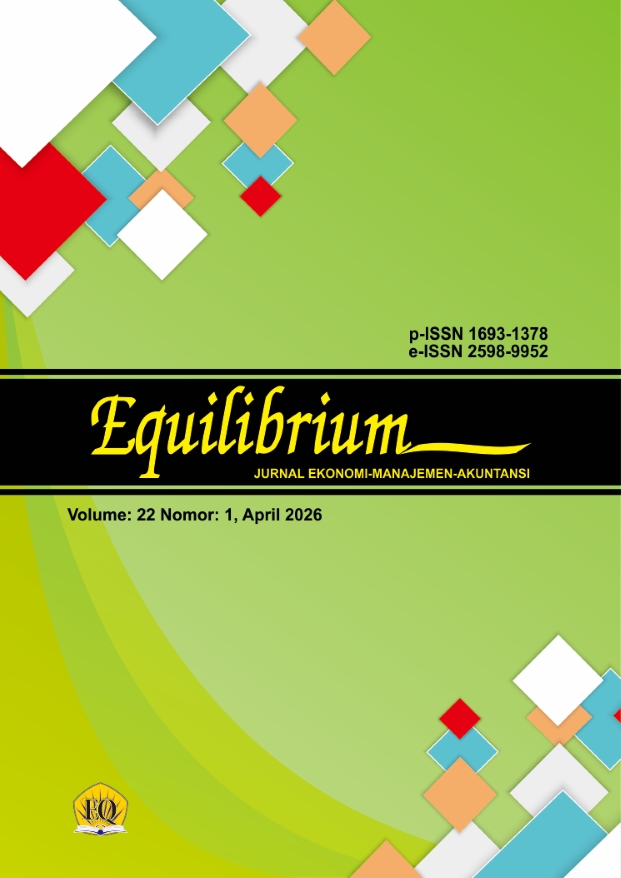
Copyright (c) 2026 Equilibrium: Jurnal Ekonomi-Manajemen-Akuntansi

This work is licensed under a Creative Commons Attribution-ShareAlike 4.0 International License.
Authors who publish with this journal agree to the following terms:
- Authors retain copyright and grant the journal right of first publication with the work simultaneously licensed under a Attribution-ShareAlike 4.0 International (CC BY-SA 4.0) License that allows others to share the work with an acknowledgement of the work's authorship and initial publication in this journal.
- Authors are able to enter into separate, additional contractual arrangements for the non-exclusive distribution of the journal's published version of the work (e.g., post it to an institutional repository or publish it in a book), with an acknowledgement of its initial publication in this journal.
- Authors are permitted and encouraged to post their work online (e.g., in institutional repositories or on their website) prior to and during the submission process, as it can lead to productive exchanges, as well as earlier and greater citation of published work