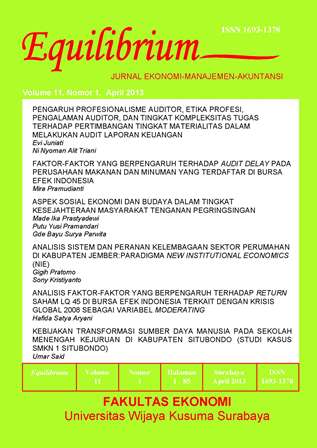
PENGARUH PROFESIONALISME AUDITOR, ETIKA PROFESI, PENGALAMAN AUDITOR, DAN KOMPLEKSITAS TUGAS TERHADAP PERTIMBANGAN TINGKAT MATERIALITAS DALAM MELAKUKAN AUDIT LAPORAN KEUANGAN
DOI:
https://doi.org/10.30742/equilibrium.v11i1.92Abstract
This study aimed to determine the effect of auditor professionalism, professional ethics, auditor experience and task complexity on the level of materiality considerations. The population in this study is the auditor who worked on the public accounting firm in the area of Surabaya. Sampling technique in this study using a convenience sampling, the sample selection is based on the ease of obtaining the data. Data obtained using a questionnaire survey. Analysis tool used is multiple linear regression using SPSS.
The results showed that professionalism auditor effect on consideration the level of materiality, which is indicated by value sig of 0,000; professional ethical effect on consideration the level of materiality, which is indicated by value sig of 0,008; experiences auditor effect on consideration the level of materiality, indicated by value sig of 0,000, and the complexity of the task does not effect the consideration of materiality levels, indicated by value sig of 0,21. The professionalism of the auditor, professional ethics, experience and the complexity of the task auditors jointly effect the consideration of materiality levels, indicated by the sig value of 0,000.
References
Abdolmohammadi, M. & Wright, A. 1987. “An Examination of The Effects of Experience and Task Complexity on Audit Judgmentâ€. The Accounting Review. Vol LXII, No 1: 1-13
Arens, A. A., Renal, J. E. & Beasly, M.S. 2005. Auditing and Assurance Services, an Intergrated Approach. New Jersey: Prentice Hall.
Bandura, A. 1986. Social Foundations of Thought and Action: A Social Cognitive Theory. Englewood Cliffs, NJ: Prentice-Hall.
Boynton, W., Johnson, R.N. & Kell, W.G. 2001. Modern Auditing. Seventh Edition. Terjemahan oleh Paul A. Rajoe, Gina Gania, Ichsan Setiyo Budi. 2002. Jakarta: Erlangga.
Chung, J. & Monroe, G. S. (2001). “A Research Note on the Effects of Gender and Task Complexity on an Audit Judgmentâ€. Behavioral Research in Accounting, 13: 111-125.
Febrianty, 2012. “Pengaruh Profesionalisme Auditor terhadap Pertimbangan Tingkat Materialitas Audit atas Laporan Keuanganâ€. Jurnal Ekonomi dan Informasi Akuntansi, 2 (2): 1-42
Ghozali, I. 2009. Aplikasi Analisis Multivariate dengan Program SPSS. Semarang: Badan Penerbit Universitas Diponegoro.
Hastuti, I. & Susilawati. 2003. “Hubungan antara Profesinalisme Auditor dengan Pertimbangan Tingkat Materialitas dalam Proses Pengauditan Laporan Keuangaâ€. Jurnal Simposium Nasional Akuntansi VI, Surabaya, 16-17 Oktober 2003, hlmn 06-16
Herawaty, A. & Susanto, Y.K.. 2009. “Pengaruh Profesionalisme, Pengetahuan Mendeteksi Kekeliruan dan Etika Profesi Terhadap Pertimbangan Tingkat Materialitas Akuntan Publikâ€. Jurnal Akuntansi dan Keuangan. Vol 11:13-20.
http://ekonomi.inilah.com/read/detail/158634/wow-8-auditor-terkena-sanksi-pembekuan#.U8h41JSSwbg
Ikatan Akuntansi Indonesia. 2009. Standar Profesional Akuntan Publik. Jakarta: Salemba Empat.
Iriyadi dan Vannywati. 2011. “Pengaruh Profesionalisme Auditor dan Etika Profesi Auditor terhadap Pertimbangan Tingkat Materialitasâ€. Jurnal Ilmiah Ranggagading, 11 (2): 75-81
Jamilah, Siti, Zainal Fanani & Grahita Candrarin. 2007. “Pengaruh Gender, Tekanan Ketaatan dan Kompleksitas Tugas Terhadap Audit Judgementâ€. Jurnal Simposium Nasional Akuntansi X, Unhas Makasar 26-28 Juli 2007, hlmn 1-30
Kusuma, N. F. B. A.. 2012. Pengaruh Profesionalisme Auditor, Etika Profesi dan Pengalaman Auditor terhadap Pertimbangan Tingkat Materialitas. Skripsi. Yogyakarta: Universitas Negeri Yogyakarta.
Mayangsari, S. 2003. “Pengaruh Keahlian Audit dan Independensi terhadap Pendapat Auditâ€. Jurnal Riset Akuntansi Indonesia. Vol 6: 1-22.
Murtanto & Marini. 2003. “Persepsi Akuntan Pria dan Akuntan Wanita serta Mahasiswa dan Mahasiswi terhadap Etika Bisnis dan Etika Profesiâ€. Jurnal Simposium Nasional Akuntansi VI, Surabaya 16-17 Oktober.
Mutiasari, A. 2012. Studi tentang Gender, Pengalaman Auditor Eksternal, dan Kompleksitas Tugas serta Pengaruhnya terhadap Pertimbangan Tingkat Materialitas pada Kantor Akuntan Publik di Surabaya. Skripsi. Surabaya: Universitas Airlangga.
Noviyani, P. & Bandi. 2002. Pengaruh Pengalaman dan Pelatihan Terhadap Struktur Pengetahuan Auditor Tentang Kekeliruan. Simposium Nasional Akuntansi V. pp: 481-488.
Peraturan Kementerian Keuangan Republik Indonesia. 2012. Penyajian dan Pengungkapan Laporan Keuangan Emiten atau Perusahaan go public.
Restuningdiah, Nurika dan Indriantoro, Nur. 2000. “Pengaruh Partisipasi terhadap Kepuasan Pemakai dalam Pengembangan Sistem Informasi dengan Kompleksitas Tugas, Kompleksitas Sistem dan Pengaruh Pemakai Sebagai Moderating Variabelâ€. Jurnal Riset Akuntansi Indonesia, Vol 3, No. 2
Sanusi, Zuraidah Mohd, Iskandar & Poon. 2007. “Effect of Goal Orientation and Task Comlexity on Audit Judgement Performanceâ€. Malaysian Accounting Review, 6 (02): 2-18
Sinaga, Marfin & Jaka Isgiyarta. 2012. “Pengaruh Profesionalisme Terhadap Tingkat Materialitas dalam Proses Pengauditan laporan Keuangan (Studi Empiris pada Auditor Eksternal di Kota Semarang)â€. Diponegoro Journal Of Accounting, 1(2): 1-10.
Zulaikha. 2006. “Pengalaman Interaksi Gender, Kompleksitas Tugas dan Pengalaman Auditor terhadap Audit Judgmentâ€. Jurnal Simposium Nasional IX, Padang 23-26 Agustus.
Downloads
Published
Issue
Section
License
Authors who publish with this journal agree to the following terms:
- Authors retain copyright and grant the journal right of first publication with the work simultaneously licensed under a Attribution-ShareAlike 4.0 International (CC BY-SA 4.0) License that allows others to share the work with an acknowledgement of the work's authorship and initial publication in this journal.
- Authors are able to enter into separate, additional contractual arrangements for the non-exclusive distribution of the journal's published version of the work (e.g., post it to an institutional repository or publish it in a book), with an acknowledgement of its initial publication in this journal.
- Authors are permitted and encouraged to post their work online (e.g., in institutional repositories or on their website) prior to and during the submission process, as it can lead to productive exchanges, as well as earlier and greater citation of published work