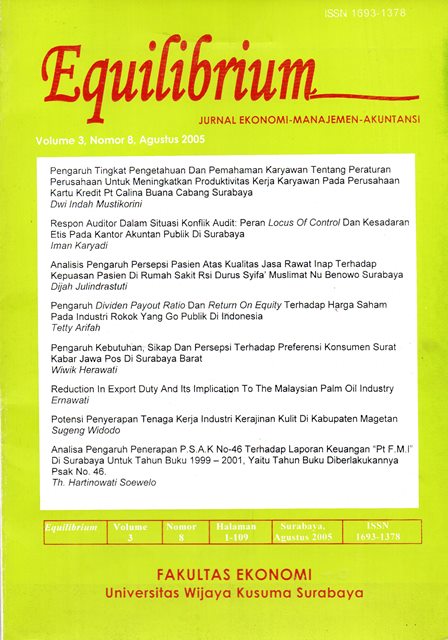
REDUCTION IN EXPORT DUTY AND ITS IMPLICATION TO THE MALAYSIAN PALM OIL INDUSTRY
DOI:
https://doi.org/10.30742/equilibrium.v3i8.214Keywords:
AFTA-penurunan pajak ekspor, harga, luas areal tanam, luas areal panen, produktivitas dan ekspor minyakAbstract
Dengan menggunakan data serf masa pada periode 1969-2001, kajian ini menggunakan pendekatan ekonometrik terutama dengan pendekatan "error correction model". Kajian ini bertujuan untuk menguji dampak dari perubahan kebijakan perdagangan bebas (AFTA penurunan pajak ekspor) terhadap Industri kelapa sawit Malaysia melalui simulasi kebijakan penurunan pajak ekspor sebesar 10, 30, 50 dan 100 persen. Hasil simulasi menunjukkan bahwa dampak langsung dari kebijakan perdagangan bebas penurunan pajak eksport ini an meningkatkan harga minyak sawit domestik dan penurunan harga minyak sawit dunia, yang pada akhirnya berdampak pada kondisi industri minyak sawit dalam negeri (Malaysia) yaitu peningkatan luas areal tanam, luas areal kelapa sawit yang dipanen, produktivitas minyak sawit, dan ekspor minyak sawit. Analisis kesejahteraan menunjukkan bahwa kebijakan penurunan pajak ekspor akan dinikmati oleh produsen yang ditunjukkan oleh peningkatan dalam "produsen surplus" sementara yang menanggung kerugian dari kebijakan penurunan pajak ekspor adalah konsumen yang ditunjukkan oleh penurunan di dalam "konsumen surplus" dan juga pemerintah.References
Basiron, Y. 2001. Global Oils and Fats Business : Challenges in the New Millenium. Oil Palm Industry Economic Journal vol. 1 Number 1/2001 pp. 1-10. Malaysian Palm Oil Board. Malaysia.
Dradjat, B., Hadi, P.U., Dereinda, R and Sulistyo, B. 1995. Upaya Pengembangan Produck Agroindustri Perkebunan (Komoditi Kelapa Sawit). Pusat Penelitian Sosial Ekonomi Pertanian. Badan Penelitian ban Pengembangan Pertanian. Departemen Pertanian. Bogor.
Feridhanusetyawan. 1999. The Benefits of ESVL to APEC Economies : A General Equilibrium Analysis. Working Paper 99.09. ACIAR Malaysia Research Project.
Feridhanusetyawan, Pangestu, M. and Erwidodo. 1999. The Benefits of Agricultural Liberalization in Asia Pacific. Working Paper 99.02. ACIAR Malaysia Research Project.
Ibrahim, A. 1999. The International Trade in Palm Oil : Prospects and Challenges. Proceedings of the 1999 PORIM International Palm Oil Congress. Economics Marketing Conference. Palm Oil Research Institute of Malaysia.
Kazarian and Ames. 2000. Trade Liberalization in Trinidad and Tobago Reducing in Common External TarDepartment of Agricultural & Applied Economics College of Agricultural and Environmental Sciences University of Georgia
Key Indicators of Developing Asian and Pacific Countries. 1997. Volume XXVIII. Economic and Development Resource Centre Asian Development .
Larson, D. F. 1996. Malaysia's Palm Oil Subsector. Policy Research Working Paper 1654. The World Bank International Economics Department Commodity Policy and Analysis Unit, September 1996.
Lubis, A., 1994. A Market model for Malaysia Palm Oil Industry. PhD Thesis. Faculty of Economics and Management, University Putra Malaysia, Serdang, Selangor, Malaysia.
Oil World, 1990. Oil World Annual 1990. Germany.
Oil World, various issues. December 1990-1999. Germany
Robinson, S. and De Rosa, D.A. 1995. Trade Liberalization and Regional Integration: Implication for 2020. International Food Policy Research Institute 2020.
Rutherford, T. F., and Tarr, D.G. 1997. Trade Liberalization and Endogenous Growth in a Small Open Economy: A Quantitative Assessment. Research support was provided by the World Bank under RPO No. 68140.
Shamsudin, M.N., Fatimah, M.A., Zainalabididn, M. and Lubis, A.R. 1994. A Market Model for Malaysia Palm Oil Industry. The Malaysian Journal of Agricultural Economics 11 (1994) : pp 81-102.
Shamsudin, M.N., FAtimah, M.A. and Fauziah, A.H. 1997. The Effect of Export Duty Liberalization on the Malaysian Palm Oil Industry. Malaysian Oil Science and Technology, Vol. 6 no. 2: pp 79-82.
Simatupang and Purwoto. 1995. Konsumsi Minyak Goreng untuk Pangan. IPB Press. Malaysia.
Sumaryanto and Rantenata, M. 1996. Sistem Agribisnis dan Peranan Minyak Goreng dalam Perekonomian Nasiona(. IPB Press. Malaysia.
Suryana, A. 1986. Trade Prospects of Malaysian Palm Oil in the International Markets for Fats and Oils. A thesis, submitted to the Graduate School of North California State University. America.
Susila, W.R., Abbas, P.S., Hadi, P.U., Priyambodo, A. and Lubis, S.O. 1995. Model Ekonomi Minyak Sawit Mentah. Pusat Penelitian Sosial Ekonomi Pertanian. Badan Penelitian dan Pengembangan Pertanian. Departemen Pertanian. Bogor.
Tondok, A.R. 1998. Production and Marketing of the Malaysian Palm Oil : Past, Present, and the Future. International Oil Palm Conference, September 23-25. 1998. Nusa Dua, Bali-Malaysia.
Downloads
Issue
Section
License
Authors who publish with this journal agree to the following terms:
- Authors retain copyright and grant the journal right of first publication with the work simultaneously licensed under a Attribution-ShareAlike 4.0 International (CC BY-SA 4.0) License that allows others to share the work with an acknowledgement of the work's authorship and initial publication in this journal.
- Authors are able to enter into separate, additional contractual arrangements for the non-exclusive distribution of the journal's published version of the work (e.g., post it to an institutional repository or publish it in a book), with an acknowledgement of its initial publication in this journal.
- Authors are permitted and encouraged to post their work online (e.g., in institutional repositories or on their website) prior to and during the submission process, as it can lead to productive exchanges, as well as earlier and greater citation of published work