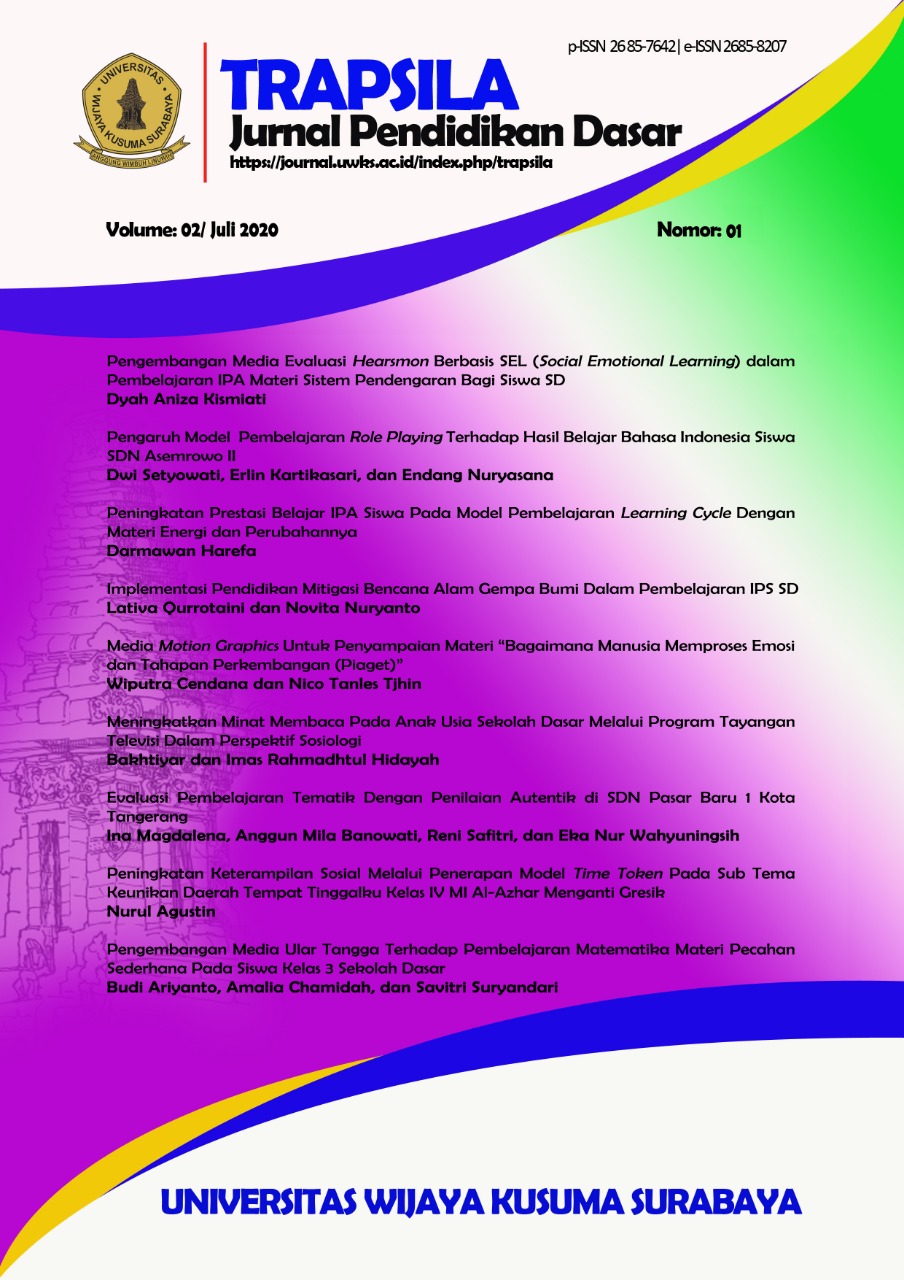
Pengembangan Media Ular Tangga Terhadap Pembelajaran Matematika Materi Pecahan Sederhana Pada Siswa Sekolah Dasar
DOI:
https://doi.org/10.30742/tpd.v2i01.917Keywords:
pendidikan guru sekolah dasarAbstract
One of the problems in the teaching and learning process is the lack of use of instructional media. This resulted in learning mathematics becoming boring and not in demand by students. So here we need a media that can be used in learning mathematics, one of which is the snake ladder media that is developed for learning mathematics for simple fraction material in elementary school students. Development research uses the ADDIE model which has 5 stages: (1) Analysis, (2) Design, (3) Development, (4) Implementation, (5) Evalution. But at the stage of the implementation of this study could not be applied because of the outbreak of COVID-19, so this study stopped at the stage of media expert validation and material validation as a measure of the feasibility of ladder snake media. The results of media validation were 90%, while the results of material validation 1 were 90% and material validation 2 were 92%. Then it can be concluded that the snake ladder media can be used for learning mathematics in simple fraction material in elementary school students.
References
Afandi, R. (2015). Pengembangan Media Pembelajaran Permainan Ular Tangga Untuk Meningkatkan Motivasi Belajar Siswa Dan Hasil Belajar IPS Di Sekolah Dasar. JINoP (Jurnal Inovasi Pembelajaran), 77-89.
Arsyad, A. (2013). Media Pembelajaran. Jakarta: PT Rajagrafindo Persada.
Cahyadi, R. A. (2019). Pengembangan Bahan Ajar Berbasis ADDIE Model. Halaqa: Islamic Education Journal, 35.
Ernawati, I., & Totok Sukardiyono. (2017). Uji Kelayakan Media Pembelajaran Interaktif Pada Mata Pelajaran Administrasi Server. Elinvo (Electronics, Informatics, And Vocational Education), 207.
Karo-Karo, I. R., & Rohani. (2018). Manfaat Media Dalam Pembelajaran. Axiom, 93.
Khayatun, A. N. (2013). Efektivitas Teknik Permainan Ular Tangga Untuk Meningkatkan Keterampilan Berbicara Bahasa Prancis Siswa Kelas XI SMAN 3 Purworejo. Skripsi tidak diterbitkan. Yogyakarta: Universitas Negeri Yogyakarta.
Khodijah, N. (2014). Psikologi Pendidikan. Jakarta: PT Rajagrafindo Persada.
Muhsetyo, G., Abadyo, Djamus Widagdo, & Elang Krisnadi. (2007). Pembelajaran Matematika SD. Jakarta: Universitas Terbuka.
Purnama, M. D., Edy Bambang Irawan, & Cholis Sa’dijah. (2017). Pengembangan Media Box Mengenal Bilangan Dan Operasinya Bagi Siswa Kelas 1 Di SDN Gadang 1 Kota Malang. Jurnal Kajian Pembelajaran Matematika, 46.
Rahmadani, A. (2019). Keefektifan Model Pembelajaran Kooperatif Tipe TGT (Team Games Tournament) pada Pokok Bahasan Pecahan Sederhana Kelas III SDN Tanjungsari 1 Sidoarjo. Trapsila: Jurnal Pendidikan Dasar, 58.
Srinivasan, K. (2018). Snake and Ladder Games in Cognition Development on Students with Learning Difficulties. Indian J Dent Adv, 160.
Sugiyono. (2019). Metode Penelitian Kuantitatif Kualitatif Dan R&D. Bandung: Alfabeta.
Tafonao, T. (2018). Peranan Media Pembelajaran Dalam Meningkatkan Minat Belajar Mahasiswa. Jurnal Komunikasi Pendidikan, 105.
Widiasworo, E. (2020). 101 Kesalahan Guru Dalam Pembelajaran. Yogyakarta: Araska.
Yuanta, F. (2011). Pengembangan Media Pembelajaran Ritatoon Untuk Siswa Kelas IV Mata Pelajaran Sains Di SDN Bareng IV Malang. Skripsi tidak diterbitkan. Malang: Universitas Negeri Malang.
Downloads
Published
Issue
Section
License
Authors who publish with this journal agree to the following terms:
a. Authors retain copyright and grant the journal right of first publication with the work simultaneously licensed under Attribution-ShareAlike 4.0 International (CC BY-SA 4.0) that allows others to share the work with an acknowledgment of the work's authorship and initial publication in this journal.
b. Authors are able to enter into separate, additional contractual arrangements for the non-exclusive distribution of the journal's published version of the work (e.g., post it to an institutional repository or publish it in a book), with an acknowledgment of its initial publication in this journal.
c. Authors are permitted and encouraged to post their work online (e.g., in institutional repositories or on their website) prior to and during the submission process, as it can lead to productive exchanges, as well as earlier and greater citation of published work (See The Effect of Open Access).
The Authors submitting a manuscript do so on the understanding that if accepted for publication, copyright of the article shall be assigned to Trapsila Journal and Research Institutions and Community Service, Program Studi Pendidikan Guru Sekolah Dasar, University of Wijaya Kusuma Surabaya as publisher of the journal.