Mental Accounting, Literasi Keuangan dan Inklusi Keuangan Terhadap Perilaku Keuangan Mahasiswa Akuntansi
DOI:
https://doi.org/10.30742/equilibrium.v20i2.4233Abstract
This study aims to examine and analyze mental accounting, financial literacy, and financial inclusion on the financial behavior of accounting students. The independent variables in this study are mental accounting, financial literacy, and financial inclusion. A quantitative research method is used in this study. The research population consists of 5th and 7th-semester accounting students from the Faculty of Economics and Business, Wijaya Kusuma University Surabaya. Using a purposive sampling technique, a sample of 114 students was selected. The data collected in this study is primary data obtained by distributing questionnaires. This study employs IBM SPSS 23 statistical tools for testing. The results show that mental accounting has a positive effect on the financial behavior of accounting students, financial literacy has a positive effect on the financial behavior of accounting students, and financial inclusion has a negative effect on the financial behavior of accounting students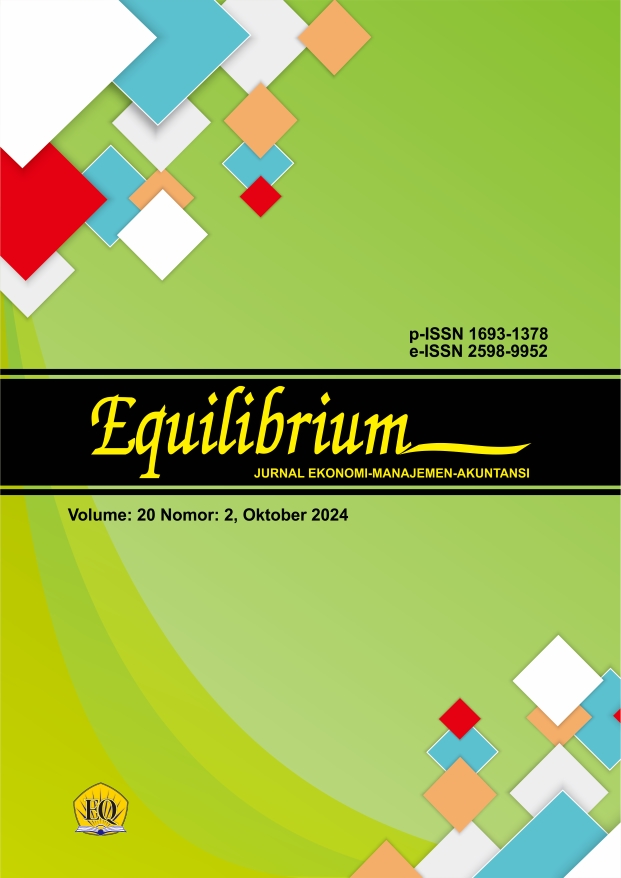
Downloads
Additional Files
Published
2025-02-03
Issue
Section
Articles
License
Authors who publish with this journal agree to the following terms:
- Authors retain copyright and grant the journal right of first publication with the work simultaneously licensed under a Attribution-ShareAlike 4.0 International (CC BY-SA 4.0) License that allows others to share the work with an acknowledgement of the work's authorship and initial publication in this journal.
- Authors are able to enter into separate, additional contractual arrangements for the non-exclusive distribution of the journal's published version of the work (e.g., post it to an institutional repository or publish it in a book), with an acknowledgement of its initial publication in this journal.
- Authors are permitted and encouraged to post their work online (e.g., in institutional repositories or on their website) prior to and during the submission process, as it can lead to productive exchanges, as well as earlier and greater citation of published work