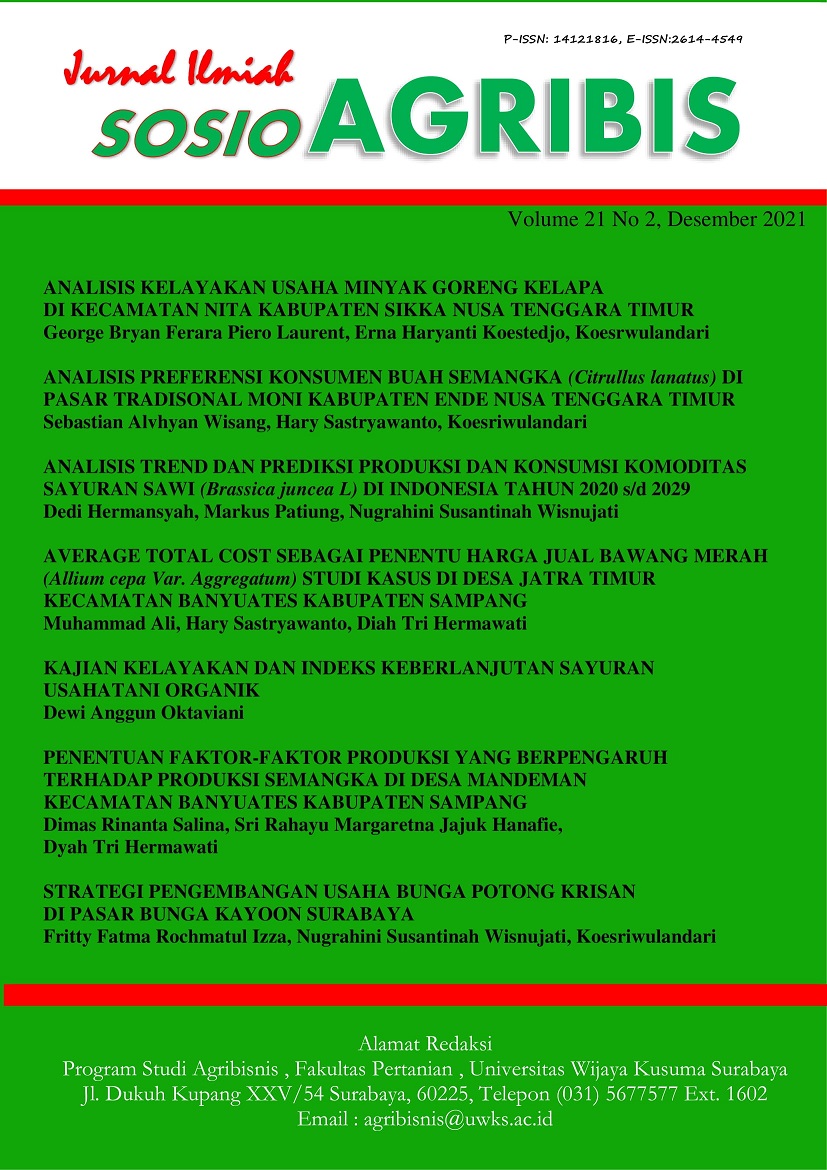
Analisis Trend dan Prediksi Produksi dan Konsumsi Komoditas Sayuran Sawi (Brassica Juncea L) di Indonesia Tahun 2020 s/d 2029
DOI:
https://doi.org/10.30742/jisa21220211383Abstract
ABSTRAK
Penelitian ini bertujuan untuk mengetahui trend estimasi produksi dan konsumsi sawi di Indonesia 10 tahun kedepan 2020 s/d 2029. Penelitian ini dilakukan di Indonesia dengan menggunakan data sekunder, dengan analisis menggunakan metode kuadrat terkecil (Least Square). Hasil penelitian ini menunjukan bahwa prediksi trend estimasi produksi komoditas sayuran sawi (Brassica juncea L) di Indonesia tahun 2020 s/d 2029 menunjukan pergerakan garis lurus dari kiri bawah ke kanan atas, bahwa untuk produksi sawi mengalami kecenderung meningkat, dengan rata-rata pertumbuhannya adalah 0,989 persen pertahun dimulai dari tahun 2020 sejumlah 649 ton, tahun2021 sejumlah 664,54 ton, tahun 2022 sejumlah 664,08 ton, tahun 2023 sejumlah 671,62 ton, tahun 2024 sejumlah 679, 16 ton, tahun 2025 sejumlah 686,7 ton, tahun 2026 sejumlah 694,24 ton, tahun 2027 sejumlah 701,78 ton, tahun 2028 sejumlah 709,32 ton, dan tahun 2029 sejumlah 716,86 ton. Prediksi trend estimasi konsumsi sayuran sawi (Brassica juncea L) di Indonesia tahun 2020 s/d 2029 menunjukan pergerakan garis lurus dari kiri bawah ke kanan atas, bahwa untuk konsumsi sawi mengalami kecenderungan meningkat, dengan rata-rata pertumbuhannya adalah 1,144 persen per tahun mulai dari tahun 2020 sejumlah 636,73 ton, tahun 2021 sejumlah 645,37 ton, tahun 2022 sejumlah 654,01 ton, tahun 2023 sejumlah 662,65 ton, tahun 2024 sejumlah 671,29 ton, tahun 2025 sejumlah 679,93 ton, tahun 2026 sejumlah 688,57 ton, tahun 2027 sejumlah 697,21 ton, tahun 2028 sejumlah 705,85 ton, dan tahun 2029 sejumlah 714,49 ton.
Kata kunci: sawi, produksi, konsumsi, trend, estimasi.
Downloads
Additional Files
Published
Issue
Section
License
- The author retains copyright and grants the journal the right of first publication with the work being simultaneously licensed under the Creative Commons Attribution License which allows others to share the work with acknowledgment of the work's authorship and initial publication in this journal.
- Authors may make additional separate contractual arrangements for the non-exclusive distribution of the published journal version of the work (for example, posting it to an institutional repository or publishing it in a book), with acknowledgment of its initial publication in this journal.
- Authors are permitted and encouraged to post their work online (for example, in institutional repositories or on their websites) before and during the submission process, as it can result in a productive exchange, as well as earlier and larger citations of published work (See The Influence Open Access).