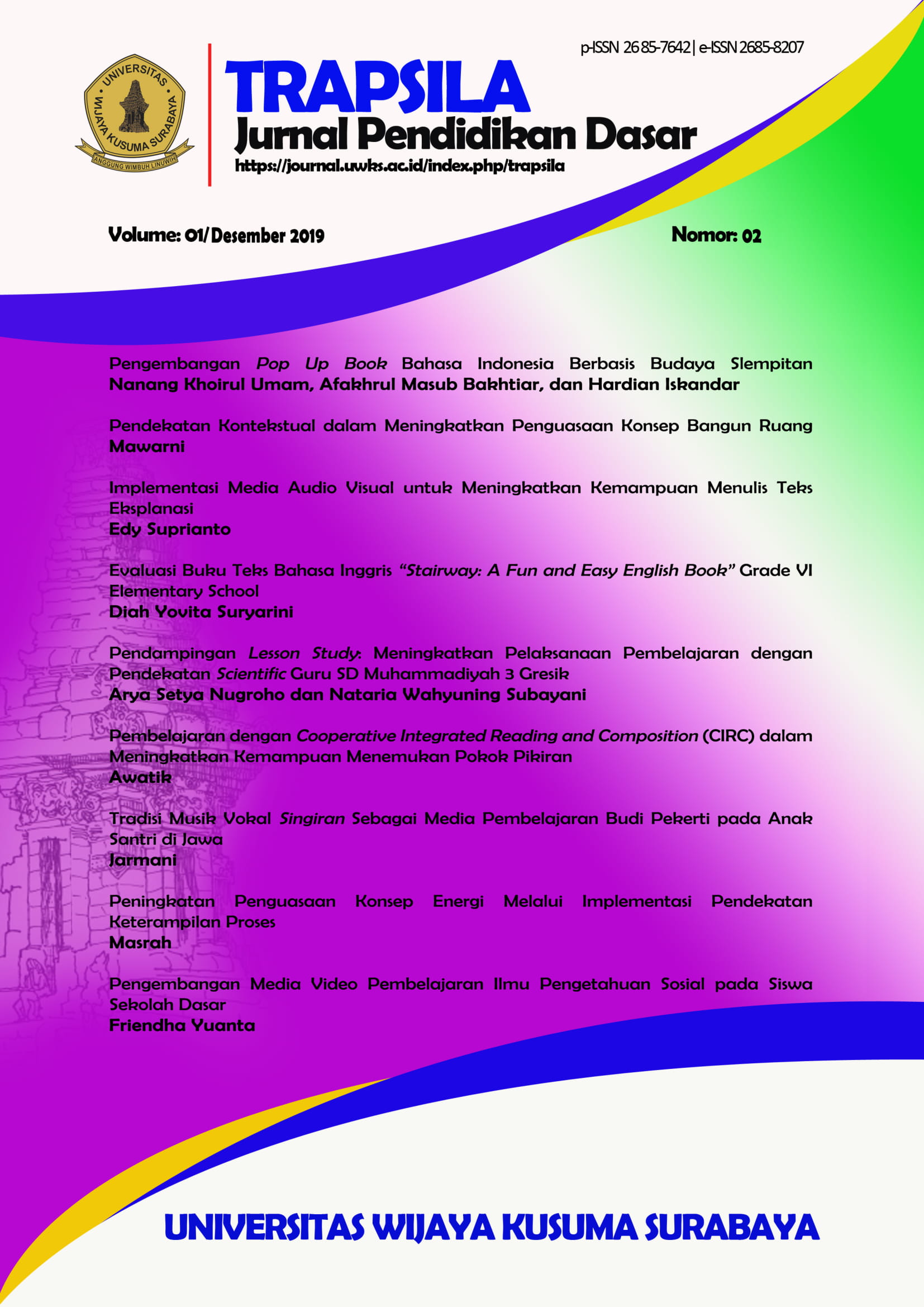
Pengembangan Media Video Pembelajaran Ilmu Pengetahuan Sosial pada Siswa Sekolah Dasar
DOI:
https://doi.org/10.30742/tpd.v1i02.816Abstract
Development of instructional media for learning valid and effective video learning media as a learning resource for social studies learning in grade IV elementary school. The development of this instructional video media uses the ASSURE model which has 6 stages: (1) analysis of students, (2) determining learning objectives, (3) choosing methods, media and materials, (4) using media and materials, (5) encouraging participation students, (6) evaluation and improvement. The subject of the development of this instructional video media is Grade IV students of SDN Pakis V. The development of this video media is declared valid to be used in social studies learning in class IV. This is obtained from the results of the validation of media experts, material experts, individual students, small groups, large groups / classical. After testing the experts and testing the students then conducted trials aimed at learning effectiveness using this instructional video media. Test results obtained in the use of instructional video media show that students have succeeded in getting grades above the specified KKM. Thus it can be denied that this instructional video learning media is effective for use in the learning process. Keywords: media development, video learning, social studies.References
Anderson, Ronald H. 1987. Pemilihan dan Pengembangan Media untuk Pembelajaran. Jakarta: Universitas Terbuka bekerja sama dengan CV. Rajawali. Arsyad, Azhar. 2001. Media Pembelajaran. Jakarta: Rajawali Press. Daryanto. 2011. Media Pembelajaran. Bandung: Satu Nusa. Ibrahim, dkk. 2005. Media Pembelajaran. Malang : Universitas Negeri Malang. Melinda, Vannisa Aviana, dkk. (2017). Pengembangan Media Video Pembelajaran IPS Berbasis Virtual Field Trip (VFT) Pada Kelas V SDNU Kraton-Kencong. JINOTEP, Volume 3, Nomor 2, April 2017. Mukminan. 1996. The Wdining Horizon or Expanding Environment Curriculum. Diakses dari https://pgsd.binus.ac.id/2018/01/0 8/karakteristik-ips-di-sekolahdasar/ Pada tanggal 20 Desember 2019. Prastowo, Andi. 2012. Panduan Kreatif Mambuat Bahan Ajar Inovatif. Yogyakarta: Diva Press. Sadeli, Lili. M., dkk. 1986. Konsep Dasar Ilmu Pengetahuan Sosial Modul 1-3. Universitas Terbuka Jakarta. Diakses dari https://pgsd.binus.ac.id/2018/01/0 8/karakteristik-ips-di-sekolahdasar/ Pada tanggal 20 Desember 2019. Sadiman, Arief. 2009. Media Pendidikan. Jakarta: PT. Raja Grafindo Persada. Sapriya. 2009. Pendidikan IPS. Bandung: PT. Remaja Rosda Karya. Smaldino, S.E., Lowther, D.L., & Russel, J.D. 2008. Instructional Technology & Media For Learning (Kesembilan ed). Terjemahan A. Rahman. 2011. Jakarta: Kencana.
Downloads
Published
Issue
Section
License
Authors who publish with this journal agree to the following terms:
a. Authors retain copyright and grant the journal right of first publication with the work simultaneously licensed under Attribution-ShareAlike 4.0 International (CC BY-SA 4.0) that allows others to share the work with an acknowledgment of the work's authorship and initial publication in this journal.
b. Authors are able to enter into separate, additional contractual arrangements for the non-exclusive distribution of the journal's published version of the work (e.g., post it to an institutional repository or publish it in a book), with an acknowledgment of its initial publication in this journal.
c. Authors are permitted and encouraged to post their work online (e.g., in institutional repositories or on their website) prior to and during the submission process, as it can lead to productive exchanges, as well as earlier and greater citation of published work (See The Effect of Open Access).
The Authors submitting a manuscript do so on the understanding that if accepted for publication, copyright of the article shall be assigned to Trapsila Journal and Research Institutions and Community Service, Program Studi Pendidikan Guru Sekolah Dasar, University of Wijaya Kusuma Surabaya as publisher of the journal.