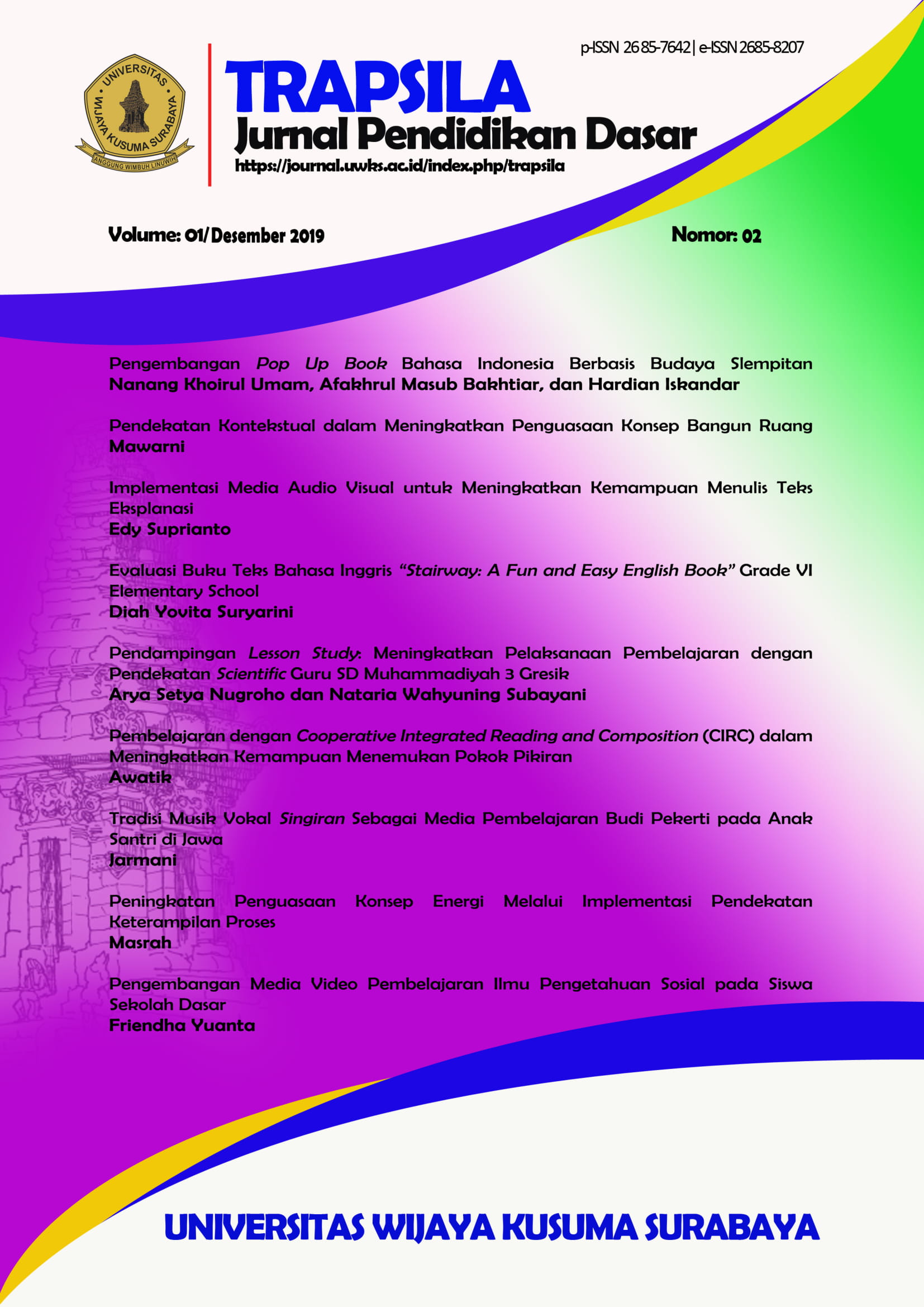
Pengembangan Pop Up Book Bahasa Indonesia Berbasis Budaya Slempitan
DOI:
https://doi.org/10.30742/tpd.v1i02.857Keywords:
Pop Up Book, Slempitan local cultureAbstract
Innovation in education world is a nuance that must always be improved, considering that time goes with the changing of era. So in the field of education there has to be a special touch in the form of innovation which is able to become an educational identity as a space for freedom from backwardness. Education is now designed to return to the local wisdom of each region so that it can produce scholars with extensive knowledge and cultured character. Slempit Village is one of the villages in Gresik Regency with unique local culture and now has to get special attention for some of them are starting to get abandoned as modern access which is marked by the construction of the Gresik-Mojokerto toll road. Various elements of society have the same responsibility for cultural preservation and especially in the world of education which focuses directly on the inculcation of values towards the nation's next generations. Based on this, the researchers conducted the Development of Indonesian Language Pop Up Book Based on Slempitan Culture. The development process is carried out with a research method of development which then gives birth to a pop-up book which is effective and relevant to be applied in the learning process, especially at SDN I Slempit regarding local culture of Slempit. The development model is done by adapting instructional development model which, according to Sadiman, 1996 (et al) consists of seven systematic stages. This study used validation instruments from the data analysis. The validation of Slempitan Culture-Based Indonesian Pop-Up Book consists of presentation / material validator as well as graphic validator. The results of the validation of the presentation obtained a score of 90% in the very feasible category. While the score obtained from the results of the graphic is 90.9% in the excellent category.References
Arikunto, Suharsimi. (2006). Prosedur Penelitian: Suatu Pendekatan Praktik. Jakarta: PT Rineka Cipta Sadiman, A. S., Rahardjo, R., Haryono, A., & Rahardjito. (1996). Media Pendidikan. Jakarta: PT. Raja Grafindo Persada. Budiyanto.(2005). Pengantar Pendidikan Inklusif berbasis Budaya Lokal.Jakarta: Depdiknas. Muslich, Masnur. (2010). Textbook Writing: Dasar-Dasar Pemahaman, Penulisan dan Pemakaian Buku Teks. Jogjakarta: Ar-Ruzz Media. Rahmawati, N. (2014). Pengaruh Media Pop-Up Book Terhadap Penguassaan Kosakata Anak Usia 5-6 Tahun TK Putera Harapan. Jurnal Mahasiswa, 1-6. Diakses 18 Februari 2018 dari Universitas Negeri Surabaya. Umam, Nanang Khoirul. (2016). Pengembangan Buku Suplemen Bahasa Indonesia Berbasis Budaya Lokal di SD Melalui Model Pembelajaran Picture and Picture (thesis). Unesa. UU No. 22 Tahun 1999 tentang desentralisasi pendidikan di Indonesia.
Downloads
Published
Issue
Section
License
Authors who publish with this journal agree to the following terms:
a. Authors retain copyright and grant the journal right of first publication with the work simultaneously licensed under Attribution-ShareAlike 4.0 International (CC BY-SA 4.0) that allows others to share the work with an acknowledgment of the work's authorship and initial publication in this journal.
b. Authors are able to enter into separate, additional contractual arrangements for the non-exclusive distribution of the journal's published version of the work (e.g., post it to an institutional repository or publish it in a book), with an acknowledgment of its initial publication in this journal.
c. Authors are permitted and encouraged to post their work online (e.g., in institutional repositories or on their website) prior to and during the submission process, as it can lead to productive exchanges, as well as earlier and greater citation of published work (See The Effect of Open Access).
The Authors submitting a manuscript do so on the understanding that if accepted for publication, copyright of the article shall be assigned to Trapsila Journal and Research Institutions and Community Service, Program Studi Pendidikan Guru Sekolah Dasar, University of Wijaya Kusuma Surabaya as publisher of the journal.