PEER REVIEW PROCESS
Peer Review Process
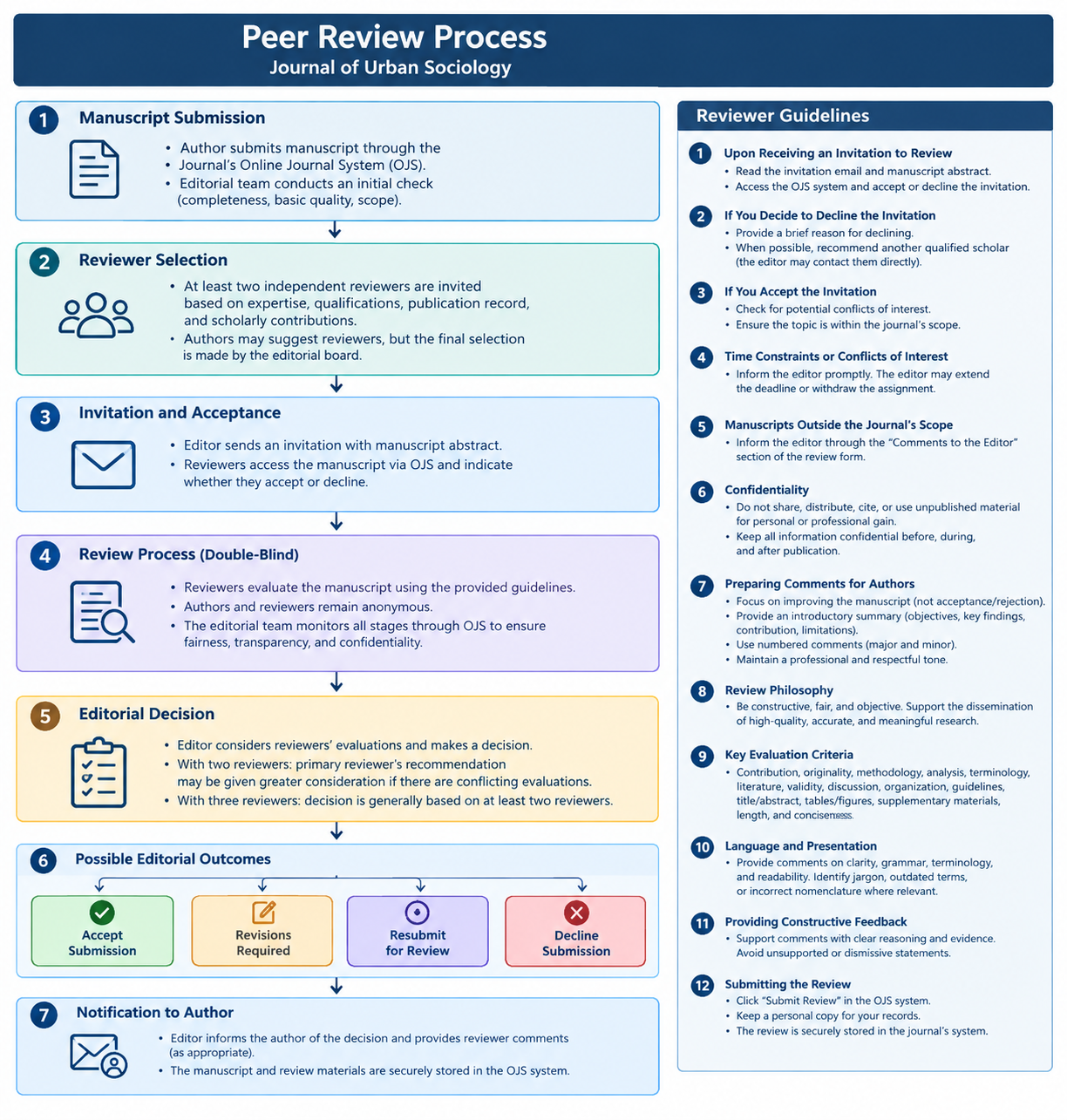
Each manuscript submitted to the journal is evaluated by at least two independent reviewers with expertise relevant to the manuscript's subject area. Authors may also recommend potential reviewers; however, the final selection of reviewers remains at the discretion of the editorial board.
Reviewers are generally selected based on their academic qualifications, research expertise, publication record, and contributions to the scholarly community. Once suitable reviewers have been identified, the editor sends an invitation to participate in the review process. Upon acceptance of the invitation, reviewers are granted access to the manuscript through the journal's Online Journal System (OJS).
The journal implements a double-blind peer-review system, in which neither the authors nor the reviewers are informed of each other's identities. All stages of the review process are administered and monitored by the editorial team through the OJS platform to ensure fairness, transparency, and confidentiality.
For manuscripts reviewed by two reviewers, the recommendation of the primary reviewer may be given greater consideration when conflicting evaluations occur. When three reviewers are involved, editorial decisions are generally based on the recommendations of at least two reviewers.
Following the completion of the review process, the editor makes a decision based on the reviewers’ evaluations. In general, editorial decisions fall into one of the following four categories:
1. Accept Submission
2. Revisions Required
3. Resubmit for Review
4. Decline Submission
Reviewer Guidelines
1. Upon Receiving an Invitation to Review
When invited to review a manuscript, reviewers are encouraged to promptly:
a. Read the editor’s invitation email, including the manuscript abstract, to determine whether the topic aligns with their expertise and whether they can complete the review within the requested timeframe.
b. Access the Journal of Urban Sociology submission system through the provided link or by logging in directly, then indicate whether they accept or decline the review invitation.
2. If You Decide to Decline the Invitation
a. Briefly explain the reason for declining the review request.
b. When possible, recommend another qualified scholar who may be able to review the manuscript. The editor may contact the suggested individual directly if deemed appropriate. Review invitations should not be transferred personally to colleagues.
3. If You Accept the Invitation
After accepting the assignment, reviewers should:
a. Examine the manuscript’s title page, acknowledgments, and any related information to identify potential conflicts of interest involving the authors, affiliated institutions, or funding sources, and ensure they can provide an objective assessment.
b. Conduct an initial review of the manuscript to confirm that the topic is relevant to the aims and scope of the Journal of Urban Sociology.
4. Time Constraints or Conflicts of Interest
If reviewers encounter scheduling difficulties or discover a conflict of interest after accepting the invitation, they should promptly inform the editor. Depending on the circumstances, the editor may extend the review deadline or withdraw the assignment.
5. Manuscripts Outside the Journal’s Scope
If the manuscript clearly falls outside the journal’s scope, reviewers should communicate this concern through the “Comments to the Editor” section of the review form.
6. Confidentiality
Manuscripts submitted for peer review are confidential documents. Reviewers must not share, distribute, cite, or use unpublished material for personal research, professional advantage, or discussion with others. All information related to the manuscript and review process must remain confidential before, during, and after publication.
7. Preparing Comments for Authors
Comments addressed to authors should focus on improving the manuscript and should not explicitly state whether the paper should be accepted or rejected. Recommendations for revision should be presented constructively rather than as conditions for acceptance.
A well-structured review should include:
-
An introductory paragraph summarizing the manuscript’s objectives, key findings, overall contribution, and principal limitations.
-
Numbered comments addressing specific issues. Where appropriate, comments may be organized into major and minor concerns.
Reviewers are expected to maintain a professional and respectful tone. Personal criticism or offensive language is unacceptable.
8. Review Philosophy
Reviewers should approach each manuscript with a constructive, fair, and objective mindset. The primary goal of peer review is to support the dissemination of high-quality, accurate, and meaningful scholarly work.
9. Key Evaluation Criteria
When reviewing a manuscript, reviewers are encouraged to consider the following aspects:
a. Contribution and significance to the relevant academic community
b. Originality and novelty of the study
c. Suitability of the research design, methodology, or analytical approach
d. Appropriateness of statistical or analytical procedures
e. Accuracy and consistency of scientific terminology
f. Relevance and adequacy of cited literature
g. Reliability and adequacy of research methods or techniques
h. Validity of interpretations and conclusions
i. Depth and relevance of the discussion
j. Overall organization and structure
k. Compliance with the journal’s author guidelines
l. Clarity and effectiveness of the title and abstract
m. Quality and relevance of tables and figures
n. Suitability of supplementary materials, where applicable
o. Overall manuscript length and conciseness
10. Language and Presentation
Reviewers are not expected to provide comprehensive copyediting. However, comments regarding clarity, grammar, terminology, and readability are appreciated. Reviewers may also identify inappropriate jargon, outdated terminology, misspelled scientific terms, or incorrect nomenclature where relevant.
11. Providing Constructive Feedback
Comments and recommendations should be supported by clear reasoning and evidence. Reviewers are encouraged to avoid unsupported or dismissive statements, particularly regarding the originality or significance of the work.
While reviewers’ recommendations play an important role in editorial decision-making, final publication decisions are made by the editor after considering multiple evaluations and relevant factors.
12. Submitting the Review
After completing the evaluation, reviewers should submit their comments through the Journal of Urban Sociology online review system by clicking the “Submit Review” button. Reviewers may also wish to keep a personal copy of their review for future reference. Once submitted successfully, the review will be securely stored in the journal’s editorial management system.